
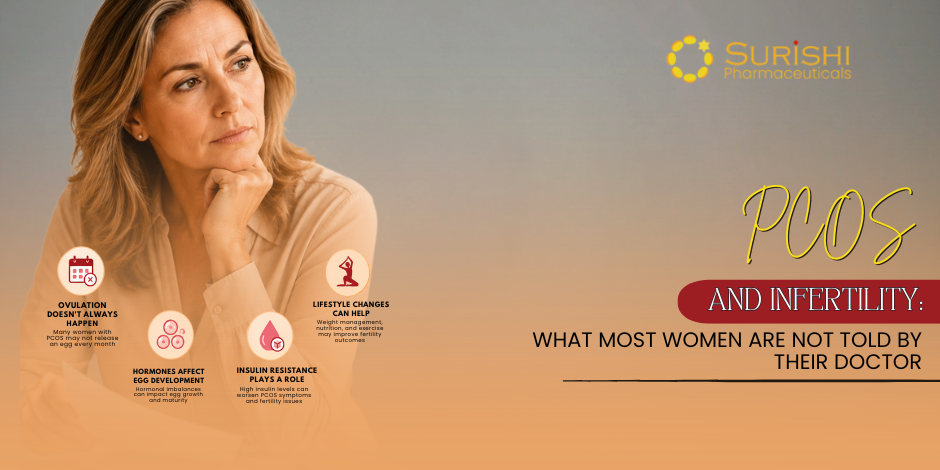
Getting a PCOS diagnosis often feels like an answer. You finally have a name for the irregular cycles, the difficult weight, and the acne. But for most women, the diagnosis is followed by a conversation about managing symptoms, not a conversation about what PCOS is actually doing to their fertility at the cellular level.
That conversation is the one most women never have. Here is what it should cover.
What Most Doctors Tell You About PCOS and Fertility
The standard clinical narrative goes something like this: PCOS causes irregular ovulation, which makes timing conception harder. If you want to get pregnant, we can help you ovulate with medication. Should that approach not succeed, the next step is IVF.
This approach is not wrong, but it is significantly incomplete. It treats ovulation as a binary problem: either an egg is released, or it is not. What it misses entirely is the quality of the egg released, and that gap in the conversation has real consequences for women with PCOS trying to conceive.
What Most Doctors Do Not Tell You: The Egg Quality Problem
Women with PCOS produce many follicles, but this situation is often framed as a positive, with more eggs to work with. This situation is often framed positively, with more eggs to work with. But quantity and quality are not the same thing, and in PCOS, the distinction matters enormously.
The PCOS environment actively damages egg quality in ways that are rarely discussed:
1. Chronic oxidative stress:
Polycystic Ovary Syndrome (PCOS) triggers excessive production of reactive oxygen species in patients, which in turn damages the DNA and mitochondria of mature oocytes, ultimately increasing the likelihood of chromosomal errors occurring during fertilization.
2. Mitochondrial dysfunction:
The hyperandrogenic and hyperinsulinemic internal environment of polycystic ovary syndrome reduces oocyte mitochondrial efficiency and impedes normal oocyte development.
3. Poor follicular fluid:
Common confounding interference of incomplete assisted reproductive intervention procedures. It confirmed that patients with polycystic ovary syndrome who completed the full course of assisted reproductive procedures still face the abnormal issue of premature ovulation of immature eggs. This core issue can significantly reduce fertilization capacity and increase the risk of related chromosomal abnormalities.
4. Immature egg release:
Patients with polycystic ovary syndrome who have completed a full course of assisted reproductive treatment may still experience the abnormal event of premature ovulation of immature oocytes, which in turn triggers two types of adverse clinical outcomes: reduced fertilization capacity and an elevated risk of chromosomal abnormalities.
This is why women with PCOS can produce 15 or 20 eggs in an IVF cycle and still end up with only 1 or 2 viable embryos. Quantity without quality does not lead to pregnancy.
What Most Doctors Do Not Tell You: Miscarriage Risk
Women with PCOS have a significantly higher rate of miscarriage than the general population, roughly 30 to 50 percent, compared to 15 to 25 percent. This information is rarely mentioned at the time of PCOS diagnosis, even in women who are trying to conceive.
The reasons are directly connected to egg quality:
- Chromosomal errors in eggs driven by oxidative stress and mitochondrial dysfunction lead to embryos that implant but cannot develop to term
- Insulin resistance disrupts the uterine environment, reducing endometrial receptivity and implantation success
- Elevated LH at the time of ovulation is associated with lower-quality eggs and higher miscarriage rates
- Chronic low-grade inflammation in PCOS impairs the immune tolerance of the embryo
Managing PCOS for fertility is not just about getting pregnant; it is about staying pregnant. And that requires addressing egg quality and the uterine environment, not just ovulation.
What Most Doctors Do Not Tell You: Miscarriage Risk:
Eggs take 90 days to mature inside the ovary before they are released. The cellular quality of any egg released today was determined by the environment in which it developed over the previous three months, including the hormonal, metabolic, and oxidative stress conditions to which it was exposed.
This means that what you do in the 90 days before a conception attempt or an IVF cycle directly affects the quality of the eggs available.
It also means that improving the ovarian environment, reducing oxidative stress, supporting mitochondrial function, and managing insulin levels have measurable effects on egg quality, but only if they are started at least 3 months in advance.
MITOV is built around this biology. As India’s first mitochondrial optimiser for female fertility, it is specifically indicated for PCOS and ovulatory dysfunction. Its formulation combines:
1. NMN:
This intervention agent can restore the depleted NAD⁺ in mature oocytes under PCOS-related metabolic stress and maintain the mitochondrial energy supply and DNA repair functions.
2. Astaxanthin:
Potent natural antioxidants can protect against oxidative damage associated with polycystic ovary syndrome. Compounds with both anti-inflammatory and sirtuin-activating activities can alleviate androgenetic inflammation and preserve oocyte DNA integrity.
3. EGCG:
Green tea extract possesses additional mitochondrial protective and insulin-sensitising properties and can be used to intervene in PCOS.
What Most Doctors Do Not Tell You: The Conversation to Have.
If you have PCOS and are planning to conceive or are already struggling to conceive, these are the questions worth raising with your specialist:
1. Is my egg quality being considered, not just my ovulation status?
2. What is my current level of oxidative stress or mitochondrial health?
3. Should I be on a preconception preparation protocol before trying to conceive or before IVF?
4. What is my miscarriage risk given my PCOS profile, and how are we addressing it?
5. Is insulin resistance being treated as part of my fertility management, not just my PCOS symptoms?
A doctor who engages with these questions is treating your fertility comprehensively, not just managing your diagnosis.
The Bottom Line.
PCOS is one of the most manageable causes of infertility, but only when it is managed comprehensively. Ovulation induction is not enough if the induced eggs have poor cellular quality. IVF is not the answer if the eggs being retrieved carry chromosomal errors from mitochondrial dysfunction and oxidative damage.
The conversation your doctor may not have had with you about egg quality, the 90-day window, mitochondrial support, and miscarriage risk is the one that makes the difference between a fertility plan that treats ovulation and one that addresses your actual biology.
Start that conversation. And start the preparation. Your eggs are maturing right now.
Frequently Asked Questions
Q: Does PCOS always cause infertility?
Not many women with PCOS conceive naturally. But PCOS is the most common cause of ovulatory infertility and significantly increases the difficulty of conception, particularly as age increases.
Q: Why do women with PCOS have more miscarriages?
PCOS-driven oxidative stress, mitochondrial dysfunction, and chromosomal errors in eggs lead to higher rates of embryo abnormality, resulting in a miscarriage rate of 30 to 50 percent compared to 15 to 25 percent in the general population.
Q: What is the best supplement for PCOS fertility?
This mitochondrial optimizer, named MITOV, is formulated with a combination of NMN, CoQ10, astaxanthin, and trans-resveratrol. Compared to single-ingredient nutritional supplements, it has a stronger targeting ability and can improve the cellular mechanisms disrupted by PCOS, as well as mitochondrial energy production and oxidative stress in mature oocytes.
Q: How early should I start preparing for pregnancy with PCOS?
At least 90 days before your planned conception attempt or IVF cycle, so the full egg maturation cycle can benefit from improved cellular support. Starting earlier is better.
Q: Can PCOS get better on its own?
Polycystic ovary syndrome cannot resolve on its own, but most women who properly implement the three categories of interventions, including lifestyle adjustments, can improve their fertility prospects.
Q: Is ovulation induction enough to treat PCOS infertility?
Ovulation induction addresses whether an egg is released, but it does not address the quality of that egg. For the best outcomes, ovulation induction should be combined with mitochondrial support and metabolic optimization in the 90 days before treatment.
(Message in Public Interest by Surishi Academic Council | Makers of MITOV)