
Polycystic ovary syndrome (PCOS) is one of the most common reasons women in India ask a difficult question: can I still get pregnant on my own? If you have searched this in a quiet, worried moment, this article is written for you — and the honest answer is more hopeful than most headlines suggest.
The short answer
Yes — many women with PCOS can get pregnant naturally. PCOS is not the same as infertility. The main obstacle is not that pregnancy is impossible; it is that ovulation (the release of an egg) can be irregular or, in some cycles, absent. Fewer ovulations in a year means fewer chances to conceive in that year, and unpredictable ovulation makes it harder to time intercourse. That can lengthen the time it takes — but for a large number of women it still happens without medical treatment, and for many others it happens with straightforward, well-established help.
It helps to keep two facts side by side. First, PCOS is the leading cause of ovulation-related infertility — around 8 in 10 women with anovulatory infertility (infertility caused by not ovulating) have PCOS. Second, when ovulation is happening — whether naturally or restored through treatment — the chance of conceiving in a given cycle is broadly similar to that of women without PCOS. In other words, the difficulty is usually about how often you ovulate, not about whether your body can conceive at all.
The rest of this guide explains why ovulation is the real question, what genuinely improves your odds, when it makes sense to see a doctor, and which treatments work — without pretending any single food, habit, or capsule is a guaranteed route to a baby.
Why ovulation is the real question in PCOS
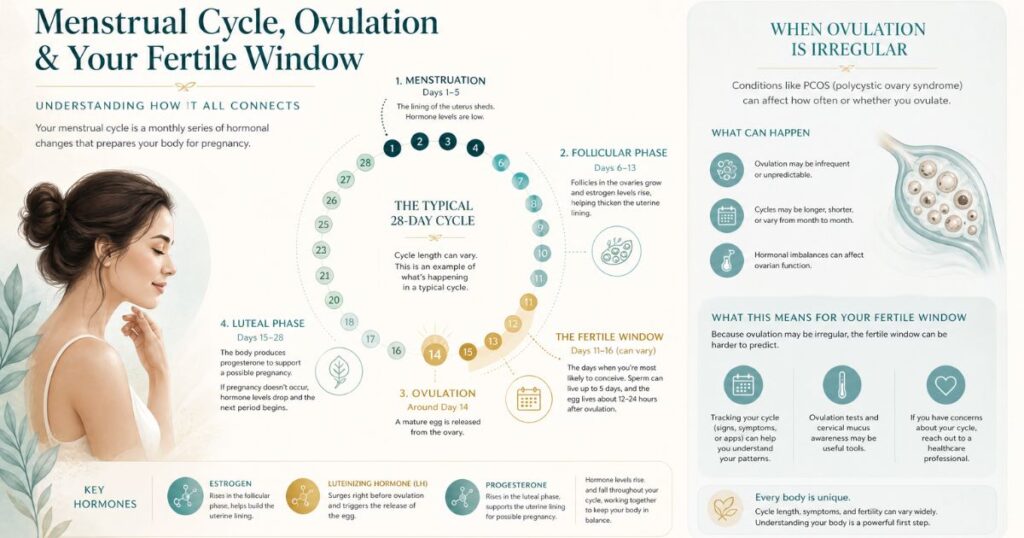
To conceive naturally, three things have to line up: an egg must be released, sperm must be present around that time, and fertilisation and implantation must follow. In most healthy cycles an egg is released roughly once a month, giving about twelve chances a year. PCOS disturbs the hormonal signals that trigger this release, so ovulation can become infrequent or irregular.
PCOS is extremely common. The World Health Organization estimates that 8–13% of women of reproductive age are affected, and that up to 70% of cases worldwide remain undiagnosed. In India, pooled estimates suggest roughly 1 in 9 adult women are affected, though figures vary widely between studies and regions depending on the diagnostic criteria used. You are far from alone.
A quick note on terminology: some professional bodies have recently proposed renaming PCOS to better reflect its hormonal and metabolic nature. For now, “PCOS” remains the term you will see everywhere — including in your doctor’s clinic — so we use it throughout.
What “irregular ovulation” actually means
Women with PCOS fall along a spectrum. Some still ovulate, just unpredictably — one cycle might be 32 days, the next 55. Others ovulate only a few times a year. A smaller group does not ovulate at all without help. Two clues that ovulation may be infrequent are cycles that are consistently longer than about 35 days, or long gaps of several months with no period at all.
Insulin resistance — where the body’s cells respond poorly to insulin, so the pancreas produces more of it — is present in a large share of PCOS cases, including in women who are not overweight. High circulating insulin can nudge the ovaries toward producing more androgens (“male-type” hormones), which further disrupts the smooth monthly signal needed for a mature egg to be released. This is why blood-sugar and metabolic health come up so often in PCOS fertility conversations.
Finding your fertile window when cycles are unpredictable
The fertile window is the handful of days leading up to and including ovulation. With regular cycles, this is reasonably easy to predict. With PCOS, it can be a moving target. Tools that some women find helpful include tracking cervical mucus changes, charting basal body temperature, and using ovulation predictor kits — though these kits can occasionally be misleading in PCOS because of hormonal quirks. If cycles are very long or absent, tracking alone often isn’t enough, and this is a reasonable point to involve a doctor who can confirm whether and when you are ovulating with a simple blood test or ultrasound.
What affects your chances of conceiving naturally with PCOS
No two women with PCOS are identical, and several factors influence how quickly natural conception happens:
- How often you ovulate. The single biggest factor. More frequent ovulation means more opportunities each year.
- Age. Fertility declines with age for everyone. Broadly, a fertile woman in her early 30s has roughly a 1-in-5 chance of conceiving in any given cycle, falling to around 1-in-20 by age 40. PCOS does not pause this clock.
- Weight and metabolic health. Excess weight can worsen ovulation and is associated with lower fertility and higher miscarriage rates in the general population — but weight is only one piece, and many women at a healthy weight also have PCOS. This is about metabolic health, not appearance or blame.
- Your partner’s fertility. Around 40–50% of couples struggling to conceive have a male-factor contribution. A semen analysis is a simple, worthwhile early step.
- Other reproductive factors. Blocked fallopian tubes, thyroid problems, and other conditions can coexist with PCOS and are checked during a fertility evaluation.
Preconception care : the groundwork that matters most
Whatever route you take, preconception care improves the odds of a healthy pregnancy and is recommended by international guidelines for every woman with PCOS who is trying to conceive. The 2023 international PCOS guideline highlights several practical steps :

- Start a prenatal supplement with folic acid before you conceive. It reduces the risk of neural-tube defects. Women with a higher body-mass index may be advised a higher dose — a decision for your doctor.
- Optimise the everyday basics. Blood pressure, blood sugar, diet quality, physical activity, sleep, and emotional wellbeing all matter. Stopping smoking and limiting alcohol are important for both partners.
- Address weight thoughtfully, without stigma. Where appropriate, even a modest reduction of around 5–10% of body weight has shown benefits for cycle regularity in studies — though the evidence base is still developing and results vary. The aim is metabolic health and restored ovulation, not a number on a scale.
- Review your medicines and existing conditions. Conditions such as diabetes and high blood pressure are best optimised before pregnancy.
A note on nutrition support: some couples use doctor-guided preconception nutrition — for example, antioxidant and micronutrient formulations intended to support egg and sperm quality. Surishi’s ASTA-CoQ10 is one such non-hormonal fertility-nutrition supplement, positioned for preconception and reproductive wellness support and intended to be used as directed by a healthcare professional. Supplements can complement preconception care, but they are not a treatment for anovulation and do not replace medical evaluation or fertility care.
When to seek a fertility evaluation
Because PCOS affects ovulation, the usual “wait a year before seeking help” advice often doesn’t apply. A widely used, evidence-based framework:
- Under 35, with regular cycles: seek evaluation after about 12 months of trying.
- Age 35–39: seek evaluation after about 6 months.
- Age 40 or older: speak to a specialist promptly, without a long wait.
- At any age — sooner if your cycles are irregular or absent, you have known PCOS, you have had two or more miscarriages, you have very painful or heavy periods, or there are known male-factor concerns.
Because irregular or absent cycles are the hallmark of PCOS, many women with PCOS reasonably seek advice earlier rather than counting out a full year. Getting evaluated early is not a sign that something is wrong — it is simply being proactive and protecting time, one of the most valuable factors in fertility. A first evaluation is usually straightforward: a review of your history and cycles, a hormone blood profile, and a pelvic ultrasound, and — depending on your situation — a semen analysis for your partner and a check that your fallopian tubes are open.
If natural conception isn’t happening : the treatment ladder
If conception is taking longer than expected, PCOS is one of the most treatable causes of infertility. Care usually escalates step by step, starting with the simplest, safest options.
First step : lifestyle and preconception optimisation
Guidelines consistently place healthy lifestyle first — not as a moral instruction, but because improving metabolic health and, where relevant, achieving modest weight change can restore ovulation in some women and improves outcomes during any subsequent treatment.
Ovulation-induction medicines
When ovulation needs a nudge, doctors use ovulation-induction medicines. The current international guideline names letrozole as the preferred first-line medicine for ovulation induction in women with PCOS who have no other infertility factors, because it is effective and supports a healthy uterine lining. Clomiphene citrate (sometimes combined with metformin) is another established option. These are prescription medicines that are chosen, dosed, and monitored by a doctor — never started or adjusted on your own. Letrozole preparations such as Surishi’s Surletro are available only through, and under the supervision of, a qualified clinician.
Metformin, a medicine that improves insulin sensitivity, is sometimes used to help with ovulation, but it is not routinely recommended for use during pregnancy in women with PCOS — another reason these decisions belong with your doctor.
Second- and third-line options
If oral medicines don’t lead to pregnancy, next steps may include injectable hormones (gonadotrophins) or a minor ovarian procedure, with careful monitoring. In vitro fertilisation (IVF) is generally a later option, when other approaches have not succeeded or when there is another specific reason for it. In assisted reproduction and early-pregnancy support, doctors sometimes prescribe progesterone to support the uterine lining — for example natural micronised progesterone such as Surishi’s SU-PREG range, used strictly under medical supervision for indications your doctor will determine. Encouragingly, most pregnancies achieved with treatment tend to occur within the first few treatment cycles.
A word on supplements and emerging evidence
You will see many supplements marketed for PCOS fertility. Some, such as myo-inositol, have promising early research suggesting benefits for insulin sensitivity and ovulation. But the evidence is still mixed and inconclusive, and current international guidelines do not endorse inositol as a first-line fertility treatment. Supplements may have a supportive role for some people, but they should be discussed with your doctor rather than treated as a substitute for proven care.
Myths vs realistic expectations
“PCOS means I’m infertile.” No. PCOS reduces how often you ovulate; it rarely removes the ability to conceive. Many women with PCOS have children — some naturally, some with help.
“If I just lose weight / cut carbs / take one supplement, I’ll get pregnant.” These steps can genuinely improve ovulation and overall health, but none of them causes pregnancy or works for everyone. Beware anything that promises a guaranteed result.
“There’s no rush.” Age still matters. If cycles are irregular, it is reasonable to seek advice earlier rather than waiting a full year.
A realistic expectation is this: conception with PCOS can take longer and may be less predictable, but the outlook is broadly positive. When ovulation is happening, per-cycle chances resemble those of women without PCOS — and with modern care, the large majority of women with PCOS who want to conceive are eventually able to. Patience, timing, and the right support usually matter more than any single “trick.”
When to seek medical care
Please speak to a qualified doctor if you:
- have cycles consistently longer than 35 days, or gaps of several months with no period;
- have been trying to conceive without success (12 months if under 35; 6 months if 35 or older; sooner at 40+);
- have had two or more miscarriages;
- are already trying and want your ovulation confirmed;
- have symptoms such as very heavy or painful periods, or signs of high blood sugar;
- feel persistently low, anxious, or overwhelmed — the emotional weight of trying to conceive is real, and support is available.
A doctor can confirm whether you are ovulating, identify any coexisting factors, and guide you to the safest, most effective next step for your situation.
The bottom line
Getting pregnant with PCOS naturally is not only possible — it is common. The condition mainly affects the timing and frequency of ovulation, not your fundamental ability to conceive. Understanding your cycle, looking after your metabolic health, starting preconception care early, and knowing when to ask for help put the odds firmly in your favour. And if you do need medical support, PCOS is one of the most treatable causes of difficulty conceiving. Wherever you are on this journey, informed and unhurried steps — with a doctor alongside you — are the surest path forward.
FAQs :
Q1. Can you get pregnant naturally with PCOS?
Yes. Many women with PCOS conceive naturally. The main challenge is irregular or infrequent ovulation, which can lengthen the time it takes — but when ovulation happens, the chance of conceiving in a cycle is broadly similar to that of women without PCOS.
Q2. Why does PCOS make it harder to get pregnant?
PCOS disturbs the hormone signals that release an egg each month. Fewer, unpredictable ovulations mean fewer chances to conceive each year and make timing intercourse harder. Insulin resistance often plays a role.
Q3. How do I know if I’m ovulating with PCOS?
Clues include cycles longer than about 35 days or long gaps with no period. Cervical-mucus tracking, basal body temperature charting, and ovulation kits can help, though kits are sometimes less reliable in PCOS. A doctor can confirm ovulation with a blood test or ultrasound.
Q4. When should I see a doctor if I have PCOS and want to get pregnant?
Under 35: after about 12 months. Age 35–39: after about 6 months. Age 40+: promptly. Because PCOS causes irregular cycles, it is reasonable to seek advice earlier rather than waiting a full year.
Q5. Does losing weight help me get pregnant with PCOS?
For some women who carry excess weight, a modest reduction of around 5–10% can improve cycle regularity and reproductive health. It is not guaranteed to cause pregnancy and isn’t relevant for everyone — the goal is metabolic health and restored ovulation, guided by your doctor.
Q6. What is the first-line medicine for PCOS-related infertility?
International guidelines name letrozole as the preferred first-line ovulation-induction medicine, with clomiphene (sometimes with metformin) as another option. These are prescription medicines, chosen and monitored by a doctor.
Q7. Do supplements like inositol help with PCOS fertility?
Early research on myo-inositol is promising for insulin sensitivity and ovulation, but the evidence is mixed and current guidelines do not endorse it as a first-line fertility treatment. Discuss any supplement with your doctor rather than relying on it alone.
Q8. Will I need IVF if I have PCOS?
Usually not as a first step. Most women with PCOS respond to simpler options such as lifestyle changes and ovulation-induction medicines. IVF is generally a later option if other approaches don’t succeed or if there is another specific reason for it.
Medical disclaimer : This content is for general information and education only. It is not a diagnosis, a treatment plan, or a substitute for professional medical advice. PCOS, fertility, and pregnancy care must be individualised by a qualified healthcare professional. Do not start, stop, or change any medicine or supplement based on this article. Prescription medicines mentioned here are used only under a doctor’s supervision. If you are trying to conceive or have concerns about your cycles or health, please consult a gynaecologist or fertility specialist.