
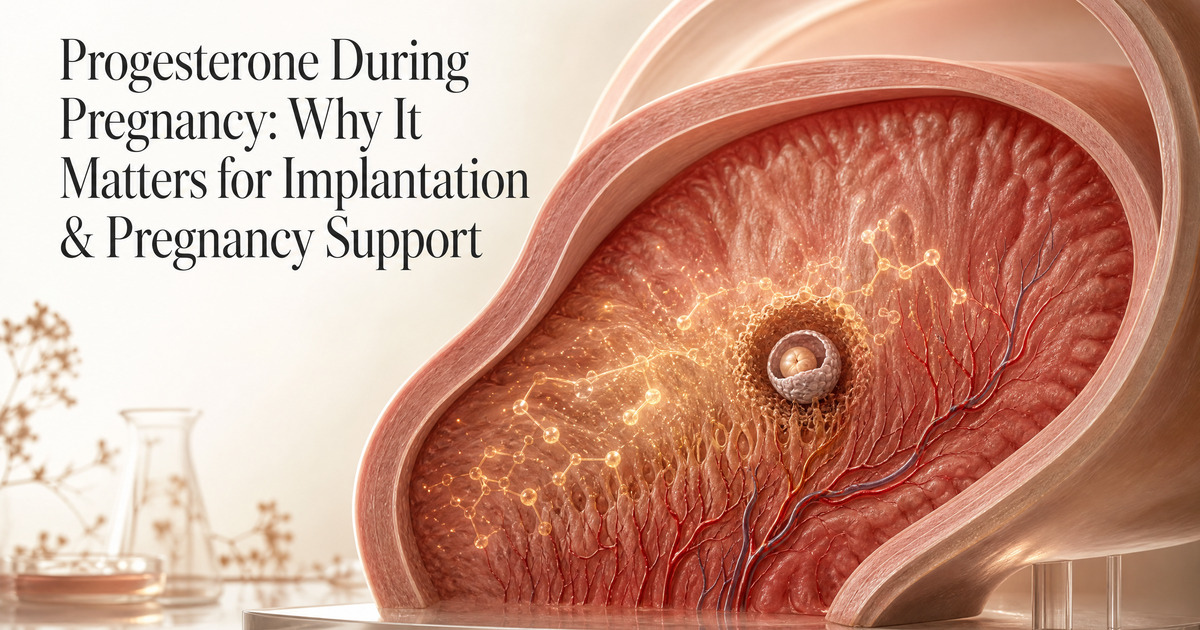
If your doctor has mentioned progesterone during pregnancy — or you have seen it discussed after a positive test, early bleeding, or a previous miscarriage — it helps to understand what this hormone actually does. In short: progesterone is the hormone that prepares the womb lining for a fertilised egg to implant, keeps the early uterus calm and supportive, and sustains a pregnancy until the placenta takes over hormone production at around 8 to 10 weeks. That is its natural, essential role.
Does that mean every pregnant woman needs progesterone supplements? No. For most pregnancies, the body makes all it needs. Progesterone (or a related medicine called dydrogesterone) is prescribed in specific situations — for example, certain fertility treatments, or early bleeding in a woman who has had a previous miscarriage — and only under medical supervision. This article explains the physiology in plain language, what current guidelines actually support, how the different formulations differ, and why progesterone should never be started or stopped on your own.
What progesterone does — the physiology
After ovulation, the empty follicle in the ovary transforms into a temporary gland called the corpus luteum, which produces progesterone. Progesterone’s job is to turn the womb lining (endometrium) into a nourishing, “secretory” surface that an embryo can implant into — a state doctors call endometrial receptivity. The ideal implantation window is roughly six to ten days after ovulation.
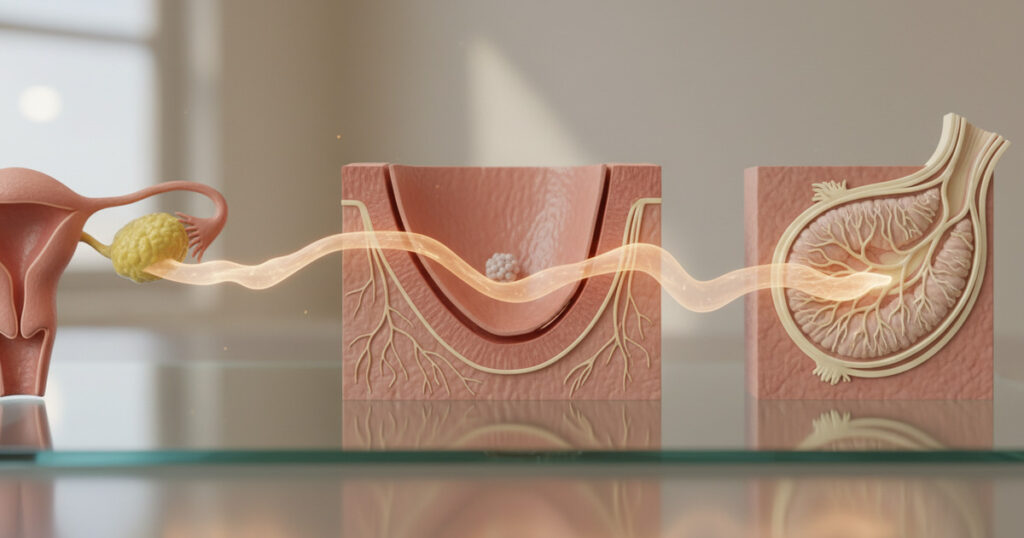
Once an embryo implants, progesterone continues to do essential work: it keeps the uterine muscle relaxed (reducing contractions), supports the lining, and helps create an immune environment that tolerates the pregnancy. If pregnancy occurs, the hormone hCG signals the corpus luteum to keep producing progesterone. Then, at around 8 to 10 weeks, the placenta gradually takes over as the main source — a hand-over known as the luteoplacental shift. This is why the first trimester is the window where progesterone support, when indicated, is most relevant.
When is progesterone used during pregnancy?
This is the heart of the topic — and where careful, guideline-based information matters most. Progesterone and progestogens are not a routine supplement for all pregnancies. Their use is targeted to specific clinical situations, decided by a doctor after proper assessment (including confirming the pregnancy is inside the womb). The main evidence-based settings are below.
Early bleeding with a previous miscarriage (threatened miscarriage)
The strongest recent evidence comes from two large UK trials. The PRISM trial (over 4,150 women with early-pregnancy bleeding) found that vaginal micronised progesterone did not significantly raise live-birth rates overall. However, in the subgroup of women who had both early bleeding and one or more previous miscarriages, there was a meaningful benefit — and it was greatest in those with three or more previous miscarriages (live-birth rate about 72% with progesterone versus 57% with placebo). The earlier PROMISE trial, in women with recurrent miscarriage, showed only a small, non-significant difference.
On this basis, the UK’s NICE guidance (updated 2021) recommends offering vaginal micronised progesterone 400 mg twice daily to women with a scan-confirmed pregnancy inside the womb who have vaginal bleeding and have had a previous miscarriage; if a heartbeat is confirmed, it is continued until 16 completed weeks. Importantly, this does not apply to women with bleeding but no history of miscarriage, and the specific benefit shown was for the vaginal route at that dose — not for every progesterone product.
Fertility treatment (luteal phase support)
In IVF and some other assisted-reproduction cycles, the natural progesterone-making process can be disrupted, so doctors routinely provide luteal phase support — usually progesterone — to help the lining stay receptive after embryo transfer. This is a well-established part of fertility care. Both vaginal micronised progesterone and oral dydrogesterone are used here (more on the difference below).
Recurrent miscarriage
For women with recurrent pregnancy loss but no current bleeding, the evidence is less clear-cut, and guidance calls for more research. Any use in this setting is an individual decision made with a specialist, ideally after investigating other treatable causes of recurrent loss. It is not a guaranteed solution, and honest counselling about uncertainty matters.
| An important honesty note Progesterone is not a general “miscarriage prevention” pill, and it cannot fix pregnancies that are not developing normally. Many early losses happen for reasons — such as chromosomal problems in the embryo — that no hormone can change. Where progesterone helps, the benefit is real but usually modest and limited to specific groups. Framing it as a cure would be misleading and unkind. |
Micronised progesterone vs dydrogesterone — not the same thing
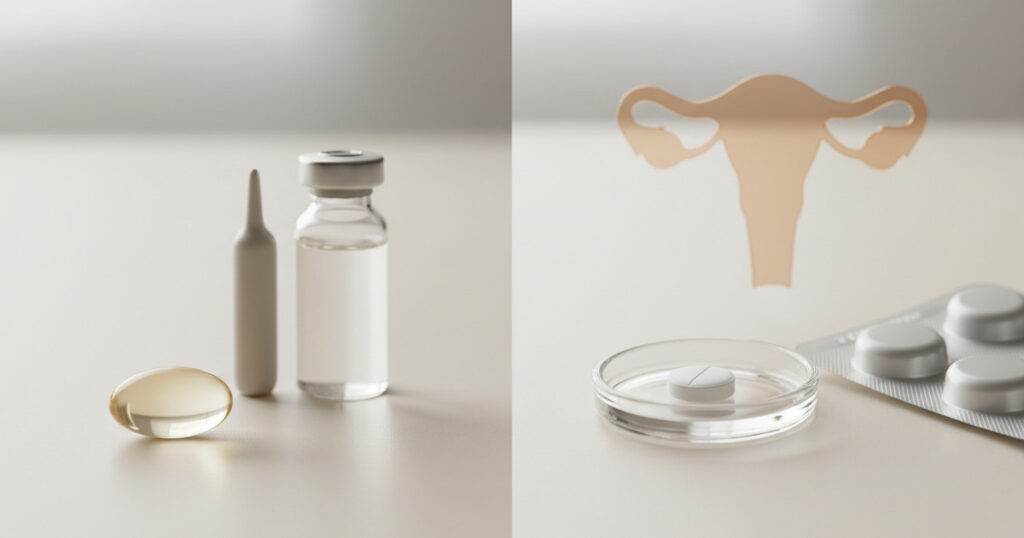
People often use “progesterone” as a catch-all, but two different medicines are commonly prescribed, and they are not interchangeable. Your doctor chooses between them based on the situation, the route that suits you, tolerability and cost.
| Micronised progesterone | Dydrogesterone | |
|---|---|---|
| What it is | Body-identical — the same molecule your body makes | A retroprogesterone: a synthetic analogue with a similar action, taken by mouth |
| Usual route | Vaginal, oral, or injection (route matters for effect) | Oral, with good absorption and generally less drowsiness |
| Notable in evidence | Vaginal 400 mg twice daily is the form supported by PRISM/NICE for bleeding + previous miscarriage | Non-inferior to vaginal micronised progesterone for IVF luteal support in the LOTUS trials |
| Common side effects | Oral: drowsiness, dizziness; vaginal: discharge, irritation | Headache, nausea, breast tenderness, menstrual changes |
| Key point | “Same as natural” — route changes how it works | Different molecule; convenient oral option |
The practical takeaway: a benefit shown for one formulation and route does not automatically transfer to another. This is exactly why choosing the medicine, route, dose and duration is a clinician’s job — not something to copy from a friend’s prescription or an online forum.
Routes and formulations, briefly
Progesterone can be given vaginally, by mouth, or by injection. Vaginal delivery acts more directly on the uterus and avoids the heavy first-pass processing of the liver, which is why it is the form used in the key miscarriage-prevention evidence; it can cause local discharge or irritation. Oral micronised progesterone is convenient but is broken down more in the body and can cause drowsiness or dizziness, so it is sometimes taken at night. Dydrogesterone is taken orally and is generally well tolerated. Each has a place; none is universally “best,” and the right choice depends on the indication and the individual.
Side effects and safety
Used appropriately under medical care, these medicines have a reasonable safety record, and the major miscarriage trials did not identify short-term safety concerns. Common, usually mild effects include drowsiness or dizziness (more with oral progesterone), headache, breast tenderness, bloating, nausea, and — with vaginal preparations — local discharge or irritation. As with any medicine taken in pregnancy, long-term effects on the child are still being studied, which is another reason use is kept to clear indications rather than given routinely. Anyone prescribed progesterone should follow their doctor’s instructions on dose and duration and report unusual symptoms.
Why you should not self-medicate with progesterone
It is understandable to want to “do everything possible,” especially after a previous loss or during anxious early weeks. But self-starting progesterone is not safe or wise, for several reasons:
- It can give false reassurance and delay urgent care. Not all early bleeding or pain is a threatened miscarriage — an ectopic pregnancy (outside the womb) is a medical emergency that progesterone will not treat.
- The pregnancy must first be confirmed to be inside the womb, usually by scan, before progesterone is appropriate.
- The right drug, route, dose and duration differ by situation — the wrong choice may do nothing useful.
- Progesterone cannot rescue a pregnancy that is not developing normally, so taking it without guidance can prolong distress without changing the outcome.
The safest, most caring step is early contact with a qualified doctor who can assess your specific situation.
Where Surishi’s products fit
Surishi’s gynaecology and pregnancy range includes both categories discussed above, as prescription options for use under a doctor’s care. SU-PREG-200 and the sustained-release SU-PREG-300-SR sit in the oral progesterone family, while SUDYDRO is a dydrogesterone product. Because these are prescription medicines, this article does not recommend any of them, state that one is right for you, or promise any pregnancy outcome — those decisions belong entirely to your treating doctor, who will choose the appropriate medicine, route, dose and duration for your situation. You can review current details on the product pages, and any questions about a specific formulation are best directed to your doctor or to Surishi’s team.
When to seek medical care
- Any vaginal bleeding, cramping or lower-abdominal pain in early pregnancy — get assessed promptly, especially to rule out ectopic pregnancy.
- Severe one-sided pain, shoulder-tip pain, dizziness or fainting — seek emergency care immediately.
- A history of one or more previous miscarriages, so a plan can be made before or early in pregnancy.
- You are undergoing or planning fertility treatment and have questions about luteal support.
- You have been prescribed progesterone and have side effects, or are unsure how or how long to take it — ask your doctor rather than stopping on your own.
| Medical disclaimer This article is for general education only and is not a substitute for professional medical advice, diagnosis or treatment. It does not diagnose any condition, promise any pregnancy outcome, or recommend a personal treatment plan. Progesterone and dydrogesterone are prescription medicines — do not start, stop, or change them, or any other medicine, based on this content. Always consult a qualified doctor or gynaecologist about your individual situation, and seek urgent care for bleeding or severe pain in pregnancy. |
FAQs :
Q1. What does progesterone do during pregnancy?
Progesterone prepares the womb lining so an embryo can implant, keeps the early uterus relaxed and supportive, and helps sustain the pregnancy until the placenta takes over hormone production at around 8 to 10 weeks. It is essential to early pregnancy, though most women make all they need naturally.
Q2. Does every pregnant woman need progesterone supplements?
No. Most pregnancies do not require any progesterone medicine. It is prescribed only in specific situations — such as certain fertility treatments, or early bleeding in a woman with a previous miscarriage — and always under a doctor’s supervision.
Q3. Can progesterone prevent a miscarriage?
In specific groups it can help modestly. Large trials showed that vaginal micronised progesterone raised live-birth rates in women who had both early bleeding and one or more previous miscarriages, with the greatest benefit in those with three or more. It is not a general miscarriage-prevention pill and cannot save a pregnancy that is not developing normally.
Q4. What is the difference between micronised progesterone and dydrogesterone?
Micronised progesterone is body-identical (the same molecule your body makes) and can be given vaginally, orally or by injection. Dydrogesterone is a related synthetic medicine taken by mouth, often better tolerated. They are not interchangeable — the choice, route and dose are decided by your doctor.
Q5. Is progesterone safe in pregnancy?
Used appropriately under medical care, it has a reasonable safety record, and major trials found no short-term safety concerns. Side effects are usually mild, such as drowsiness, headache or (with vaginal forms) local irritation. As with any medicine in pregnancy, use is kept to clear indications rather than given routinely.
Q6. Can I start progesterone on my own if I have bleeding?
No. Self-medicating is unsafe. Early bleeding needs assessment — including ruling out an ectopic pregnancy, which is an emergency progesterone cannot treat — and the pregnancy must be confirmed inside the womb first. See a doctor promptly instead of starting any medicine yourself.
Q7. How long is progesterone usually taken in early pregnancy?
It depends entirely on the indication and your doctor’s judgement. For example, current guidance for bleeding with a previous miscarriage continues vaginal progesterone until 16 completed weeks if a heartbeat is confirmed. Always follow your own doctor’s instructions rather than a general figure.