
If you have PCOS (also widely called PCOD in India), you have probably seen myo-inositol recommended everywhere — in reels, forums and supplement ads — often as an almost magical fix. Here is the honest, research-based summary up front. Myo-inositol for PCOS appears to modestly help some metabolic and hormonal features of the condition — such as insulin sensitivity and menstrual-cycle regularity — and it is generally well tolerated. But the overall evidence is limited and mixed. The 2023 international PCOS guideline concludes that inositol offers only limited clinical benefit, and that metformin has greater efficacy for metabolic features. For fertility specifically, there is no high-quality proof that myo-inositol improves pregnancy or live-birth rates.
Below, we explain what myo-inositol is, how it may work in PCOS, what the strongest current evidence says, and the practical caveats around dose, formulation, pregnancy and safety — so you can have an informed, realistic conversation with your own doctor rather than relying on the internet.
What is myo-inositol (and how is it different from ‘inositol’ and DCI)?
Inositol is a sugar-like compound your body makes and also gets from foods such as fruits, beans, grains and nuts. It exists in several forms, but two matter most in PCOS: myo-inositol (MI) and D-chiro-inositol (DCI). When a label just says “inositol,” it usually means myo-inositol, which is by far the most abundant form in the body.
Both act as “second messengers” for insulin — in simple terms, they help carry insulin’s signal inside cells so glucose is used properly. They also have distinct jobs. Myo-inositol is especially important inside the ovary, where it helps relay the FSH (follicle-stimulating hormone) signal that supports egg development. DCI is more involved in glucose storage in muscle and fat. Your body converts some MI into DCI as needed, and the two are meant to stay in balance. This division of labour is the reason the two forms are studied differently — and why more DCI is not automatically better.
Why PCOS and insulin resistance are connected
Many (though not all) women with PCOS have insulin resistance — their cells respond less well to insulin, so the body makes more of it. This higher insulin can push the ovaries to produce more androgens (“male-type” hormones), which contributes to irregular periods, acne and unwanted hair growth, and can disrupt ovulation. Importantly, insulin resistance in PCOS can occur regardless of body weight, so it affects slim women too.
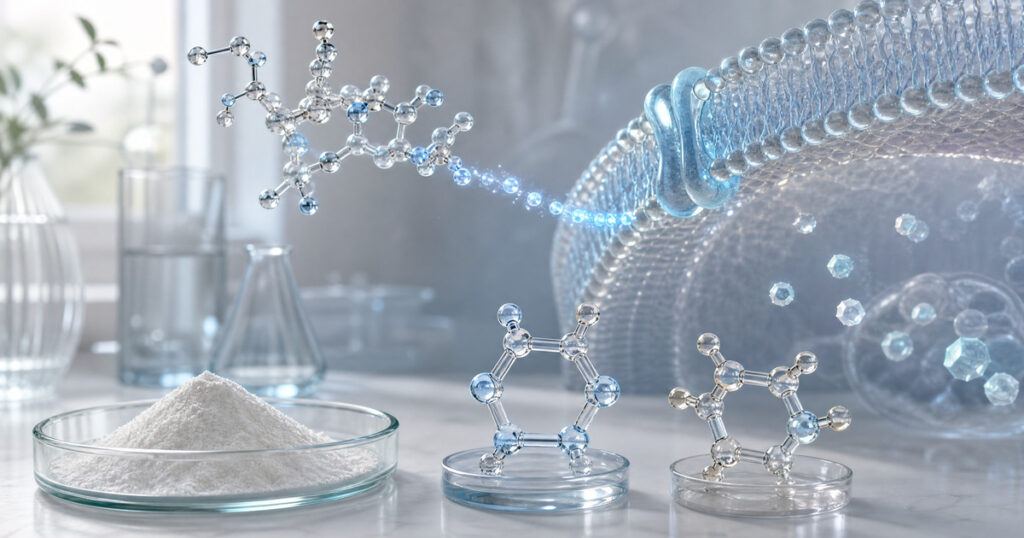
The theory behind inositol is that high insulin levels disturb the normal balance between myo-inositol and DCI inside tissues — including in the fluid around the egg — and that supplementing myo-inositol may help restore that balance and improve insulin signalling. It is a biologically reasonable idea. What matters for a health decision, though, is not the theory but what happens in actual clinical trials.
What the research says about myo-inositol for PCOS
The most authoritative recent synthesis is the systematic review that informed the 2023 International Evidence-based PCOS Guideline. It pooled 30 trials (around 2,230 participants). Its conclusion was measured: there may be benefits from myo-inositol or DCI for some metabolic measures, and a possible benefit from DCI for ovulation, but inositol may have no effect on several other outcomes. The authors described the overall evidence as limited and inconclusive, and recommended shared decision-making that weighs the uncertainty against a person’s own values and preferences.
In everyday terms, the more consistent signals in the research are around insulin sensitivity and cycle regularity, with some studies showing improvements comparable to metformin. Effects on other measures — such as fasting insulin, waist-to-hip ratio, and excess hair growth — are mixed, and here metformin sometimes performs better. None of this means myo-inositol is useless; it means the benefits are modest and not guaranteed for everyone.
| The bottom line from the guidelineThe 2023 guideline positions inositol as an option with limited clinical benefit, not a first-line treatment. Combined oral contraceptive pills remain first-line for cycle irregularity and hyperandrogenism, and metformin is preferred for metabolic features. Any decision about supplements should be individual and doctor-guided. |
Myo-inositol and fertility: what we know and what we don’t
This is where marketing and evidence part ways most sharply. A Cochrane review of myo-inositol in subfertile women with PCOS (13 trials, roughly 1,470 women, mostly as pre-treatment before IVF) found the evidence to be of low to very-low quality. The reviewers concluded they were uncertain whether myo-inositol improves live-birth or clinical-pregnancy rates, and uncertain whether it reduces miscarriage. In plain language: we cannot currently say that myo-inositol helps you have a baby.
There is a more plausible — but still unproven — role as a supportive measure alongside medical fertility care, and some clinicians use it for that reason because it is inexpensive and generally safe. But “widely used and low-risk” is not the same as “proven to work.” If fertility is your goal, the evidence-based path is a proper assessment by a gynaecologist or fertility specialist, not a supplement bought on its own.
The 40:1 myo-inositol to D-chiro-inositol ratio, explained
You will often see products advertised as a 40:1 MI to DCI ratio. This comes from the observation that healthy blood plasma naturally contains roughly 40 parts myo-inositol to 1 part DCI, and from small trials suggesting this ratio worked best for restoring ovulation compared with other ratios. The rationale is that too much DCI may actually be counter-productive in the ovary — the so-called “DCI paradox” — so a mostly-myo-inositol blend is preferred.
Two honest caveats. First, several of the studies promoting the 40:1 ratio are small and some involve authors linked to inositol manufacturers, so independent confirmation is still limited. Second, the 2023 guideline did not elevate any specific ratio to a recommended treatment. The 40:1 blend is a reasonable, mechanism-based choice if you and your doctor decide to try inositol — but it is not a guaranteed formula, and “more DCI” products are generally best avoided.
What about pregnancy and gestational diabetes?
Myo-inositol is considered safe in pregnancy and is classified as “generally recognised as safe” as a nutrient. Interest here centres on preventing gestational diabetes (GDM) — a common concern for women with a PCOS history, who are at higher risk. Several trials and meta-analyses suggest that about 4 grams of myo-inositol a day, started before or early in pregnancy, may lower the chance of developing GDM in higher-risk women, with no serious safety signals reported.
The important qualifier: a 2023 Cochrane review rated this evidence as still limited and called for larger, higher-quality trials across different populations. Myo-inositol is not yet part of standard obstetric guidelines for preventing GDM. If you are pregnant or planning pregnancy, this is precisely the kind of decision to make with your obstetrician — not to self-start based on an article.
Dose, formulation and how long it takes
For context only — and not as a personal recommendation — the regimen most commonly studied in PCOS trials is around 4 grams of myo-inositol per day, often split as 2 grams twice daily, sometimes as a 40:1 MI:DCI blend, and frequently combined with folic acid. Studies typically run for at least three months before judging any effect, because hormonal and cycle changes take time; insulin markers may shift a little sooner.
Formulation quality varies widely between brands, and supplements are not regulated as strictly as medicines. That is why the sensible approach is to treat inositol as something to discuss with a qualified doctor, who can advise on whether it fits your situation, what form and amount make sense for you, and how it interacts with anything else you take. Please do not use these figures to self-prescribe.
Is myo-inositol safe? Side effects to know
Myo-inositol has a reassuring safety profile in the doses used for PCOS. When side effects do occur they are usually mild and dose-related — most often mild nausea, gas, or loose stools at higher intakes. In head-to-head studies it tends to cause fewer gastrointestinal side effects than metformin, which is one reason some people find it easier to tolerate. Even so, “natural” does not mean “risk-free for everyone,” and it should not be assumed safe to combine with every medication or condition without medical input.
Myo-inositol versus metformin
| Consideration | Myo-inositol | Metformin |
|---|---|---|
| Guideline status (2023) | Option with limited clinical benefit | Preferred for metabolic features; greater efficacy |
| Typical use | Supplement; insulin sensitivity, cycles | Medicine; insulin resistance, metabolic risk |
| Tolerability | Generally well tolerated; mild GI effects | Effective but more GI side effects for some |
| Fertility proof | Not established | No clear advantage for reproductive outcomes vs inositol |
| How to decide | With your doctor | With your doctor (prescription) |
This table is a simplified summary, not a recommendation to choose one over the other. The right option depends on your specific features, other health conditions and goals — a conversation for you and your clinician.
Where myo-inositol fits in PCOS care
Across every credible guideline, the foundation of PCOS management is the same: supported lifestyle — balanced eating, regular physical activity, sleep and stress care, and weight management where appropriate, all approached without shame or stigma. Medicines like the combined pill or metformin are added for specific problems. Supplements such as myo-inositol sit alongside these as a possible adjunct for some people — helpful for a few, neutral for others — never as a replacement for medical care or a cure for the syndrome. PCOS is a long-term condition that is managed, not “cured,” and steady, individualised care is what makes the biggest difference.
When to see a doctor
- Periods that are very irregular, absent for three months or more, or unusually heavy.
- Trying to conceive for 12 months without success (or 6 months if you are over 35).
- Rapidly worsening acne, excess hair growth, hair loss, or signs of high blood sugar (excessive thirst, frequent urination, unexplained fatigue).
- You are pregnant, planning pregnancy, or taking other medicines and want to add any supplement.
- Low mood, anxiety or distress related to PCOS symptoms — emotional health is part of PCOS care and deserves support.
| Medical disclaimerThis article is for general education only and is not a substitute for professional medical advice, diagnosis or treatment. It does not diagnose any condition or recommend a personal treatment plan. Do not start, stop or change any prescription medicine based on this content. Always consult a qualified doctor or gynaecologist about your individual situation — especially if you are pregnant, planning pregnancy, or managing other health conditions. |
FAQs :
Q1. Does myo-inositol really help PCOS?
It may modestly help certain features — especially insulin sensitivity and menstrual-cycle regularity — and is generally well tolerated. But the overall evidence is limited and mixed, and the 2023 international guideline rates its clinical benefit as limited. It is best seen as a possible adjunct, discussed with your doctor, rather than a cure.
Q2. Can myo-inositol help me get pregnant with PCOS?
There is no high-quality proof that myo-inositol improves pregnancy or live-birth rates. A Cochrane review found the evidence uncertain and of low quality. If you are trying to conceive, the evidence-based step is a proper assessment by a gynaecologist or fertility specialist.
Q3. What is the 40:1 ratio of myo-inositol to D-chiro-inositol?
It reflects the natural balance of the two inositols in healthy blood (about 40 parts myo-inositol to 1 part D-chiro-inositol). Small studies suggest this ratio may suit PCOS better than DCI-heavy blends, but independent evidence is still limited and no specific ratio is a guaranteed treatment.
Q4. How much myo-inositol is used in PCOS studies?
Trials most commonly use about 4 grams of myo-inositol a day, often split into two doses, for at least three months. These are research figures, not a personal recommendation — the right choice for you should be decided with a qualified doctor.
Q5. Is myo-inositol safe? What are the side effects?
It has a reassuring safety profile at usual doses. Side effects are usually mild and dose-related, such as nausea, gas or loose stools at higher intakes, and it tends to cause fewer stomach-related effects than metformin. Check with your doctor before combining it with other medicines.
Q6. Is myo-inositol safe in pregnancy?
Myo-inositol is generally regarded as safe in pregnancy, and some research suggests it may help lower the risk of gestational diabetes in higher-risk women. However, the evidence is still limited and it is not part of standard obstetric guidelines, so use it only under your obstetrician’s guidance.
Q7. Myo-inositol or metformin — which is better for PCOS?
They are not directly interchangeable. The 2023 guideline prefers metformin for metabolic features, while myo-inositol is generally better tolerated. There is no clear winner for fertility outcomes. The right option depends on your individual profile and is a decision for you and your doctor.