
If you are here because your periods have become unpredictable, or because you have noticed unwanted hair, stubborn acne, or trouble managing your weight, you are not alone — and you are asking the right questions. PCOS symptoms are one of the most common reasons women in India visit a gynaecologist, and PCOS (polycystic ovary syndrome) is the most common hormonal condition in women of reproductive age, affecting an estimated 8–13% of women worldwide [1][4].
Here is the short version, before the detail: PCOS is a hormonal and metabolic condition, not a single disease with a single cause. It is diagnosed by a doctor using a specific set of criteria — not by one blood test or one scan alone. It cannot currently be “cured,” but for most women it can be managed well, and doing so early protects both day-to-day wellbeing and long-term health. This guide explains the symptoms, how diagnosis actually works, and the evidence-based options — so you can have a more informed conversation with your own doctor.
What is PCOS?
PCOS stands for polycystic ovary syndrome. Despite the name, it is not primarily a problem of “cysts” in the way most people imagine. The “polycystic” appearance on a scan actually refers to a larger-than-usual number of small, immature follicles sitting in the ovaries — not painful cysts that need removing. At its core, PCOS is a condition in which the ovaries, certain hormones (particularly androgens), and the body’s handling of insulin fall out of their usual balance [12].
You may also hear the term PCOD (polycystic ovarian disease). In everyday Indian usage the two words are often used interchangeably. Clinically, the internationally recognised term is PCOS, and that is the term used in current medical guidelines, so we use it throughout this guide.
Three features tend to travel together in PCOS, and a woman may have some but not all of them:
- Ovulatory dysfunction — the ovaries do not release an egg regularly, which usually shows up as irregular, infrequent, or absent periods.
- Hyperandrogenism — higher-than-typical levels or effects of “male-type” hormones (androgens), which can cause acne, excess hair, or scalp hair thinning.
- Polycystic ovarian morphology — the characteristic appearance of many small follicles on an ultrasound (or, in adults, a raised AMH level).
Because PCOS is a syndrome — a cluster of features rather than one fixed picture — it looks different from woman to woman. That variability is exactly why self-diagnosis is unreliable and why a proper medical assessment matters.
Common symptoms of PCOS
PCOS symptoms vary widely, and having one or two of them does not automatically mean you have PCOS — many can have other explanations. Still, the following are the patterns most commonly linked to the condition.
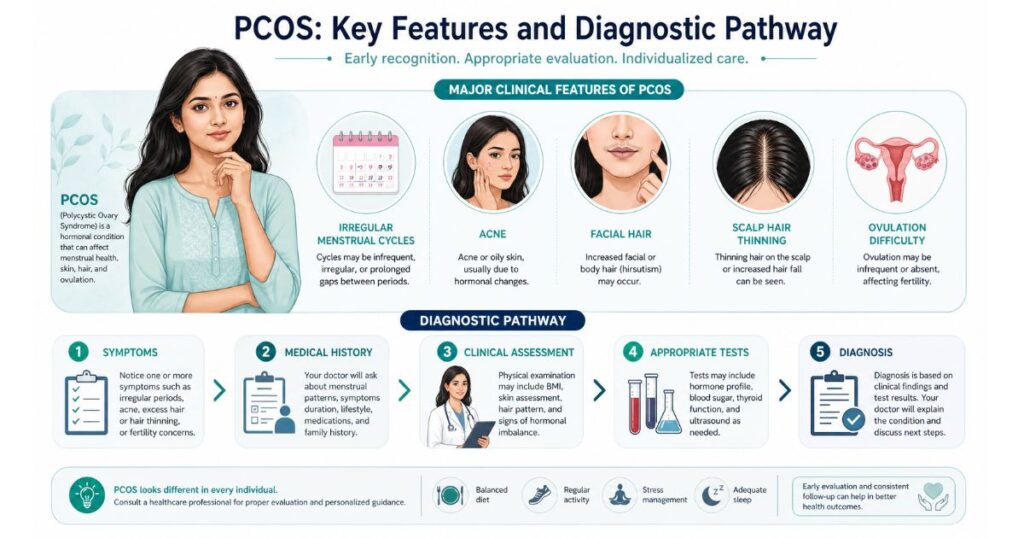
Menstrual and ovulation-related
- Irregular cycles — periods that come too far apart, unpredictably, or stop for months.
- Very infrequent periods, or (less often) heavy or prolonged bleeding when they do come.
- Difficulty conceiving, which is often linked to irregular ovulation.
Irregular or absent periods are one of the most common signs, because they reflect the ovulatory dysfunction at the heart of the condition.
Androgen-related (skin and hair)
- Hirsutism — coarse, dark hair in a “male-pattern” distribution, such as on the upper lip, chin, chest or lower abdomen.
- Persistent acne, especially along the jawline, that does not respond to usual skincare.
- Scalp hair thinning or hair fall in a female-pattern.
Metabolic and skin signs
- Difficulty losing weight, or weight gain concentrated around the middle.
- Acanthosis nigricans — velvety, darker patches of skin, often at the neck, underarms or groin, which can be a visible sign of insulin resistance.
- Fatigue or energy dips, sometimes after meals.
It is worth repeating: symptoms sit on a spectrum. Some women have prominent skin and hair changes; others mainly notice irregular periods; some have a “silent” metabolic picture that only shows up on blood tests. This is normal for PCOS and one reason diagnosis is delayed for so many women.
What causes PCOS?
There is no single cause of PCOS, and the honest scientific position is that it is not yet fully understood. What researchers describe is an interaction of several factors [12].
Insulin resistance is central for many women. Insulin is the hormone that helps move sugar from the blood into cells for energy. In insulin resistance, cells respond less well, so the body produces more insulin to compensate. Higher insulin levels can, in turn, push the ovaries to make more androgens and can lower a protein called SHBG that normally keeps androgens in check — nudging the whole system further out of balance. Insulin resistance is thought to be present in a large share of women with PCOS — estimates commonly cited are in the range of roughly 50–80%, and importantly it can occur even in women who are not overweight [7].
Androgens (hyperandrogenism) are the second thread. Higher androgen activity drives the skin and hair symptoms and also interferes with regular ovulation.
Genetics and family history play a role — PCOS often runs in families — as do wider lifestyle and environmental factors. None of these is “the reason” on its own; they combine differently in different women.
It is helpful to know what PCOS is not caused by: it is not caused by anything you did wrong, and it is not a moral failing or simply a matter of “eating too much.” Framing it accurately matters, because shame and misinformation often delay the very steps that help.
How PCOS is diagnosed
Diagnosis is made by a doctor, and current international practice follows the 2023 International Evidence-Based Guideline, which updated the long-used Rotterdam criteria into evidence-based criteria [1][3].
For adults, PCOS is diagnosed when two of the following three are present, after other causes have been excluded [1]:
- Clinical or biochemical hyperandrogenism (signs such as hirsutism, or raised androgens on a blood test).
- Ovulatory dysfunction (typically irregular or absent periods).
- Polycystic ovarian morphology on ultrasound — or, and this is new in 2023, a raised anti-Müllerian hormone (AMH) blood level, which adults can now use as an alternative to the scan [3][5].
A practical simplification from the 2023 update: if a woman clearly has both irregular cycles and hyperandrogenism, an ultrasound or AMH test is not required to make the diagnosis [1].
Excluding other causes is essential. Several conditions can mimic PCOS, so doctors typically check thyroid function, prolactin, and sometimes 17-hydroxyprogesterone (for late-onset congenital adrenal hyperplasia), and consider rarer causes such as Cushing’s syndrome or androgen-secreting tumours before settling on a PCOS diagnosis [11][16]. This is why “PCOS” should not be self-diagnosed from an ultrasound report alone.
An important caveat for teenagers
Adolescents are diagnosed differently, and this is where a lot of online information goes wrong. In the years after a girl’s first period, irregular cycles and a “multi-follicular” ovary appearance can be completely normal parts of development. For that reason, the 2023 guideline says that in adolescents, both hyperandrogenism and ovulatory dysfunction must be present, and ultrasound and AMH are not recommended for diagnosis because they are not specific enough at this age [1][5]. A cautious doctor may describe a teenager as “at risk of PCOS” and re-evaluate over time, rather than labelling her prematurely.
Lean PCOS — when you are not overweight
A common and harmful myth is that PCOS only affects women who are overweight. In reality, some women have lean PCOS: they meet the diagnostic criteria — irregular cycles, raised androgens, or the characteristic ovaries — while having a normal body weight [10].
Lean PCOS matters for two reasons. First, it is often missed or diagnosed late, precisely because the woman “doesn’t look like she has PCOS.” Second, insulin resistance and metabolic risk are not solely about weight — women at a normal BMI can still have some degree of insulin resistance, although research suggests it tends to be less frequent and less severe than in women with higher body weight [7][10]. Research in this area is still developing. The practical takeaway is simple: if you have the symptoms, a normal weight is not a reason to rule PCOS out or to skip a proper assessment.
Common myths about PCOS
- “PCOS means my ovaries are full of dangerous cysts.” No. The follicles seen on a scan are not the harmful cysts people fear; PCOS is a hormonal and metabolic syndrome, not a cyst disease.
- “PCOS means I can never have children.” No. PCOS is a common cause of difficulty conceiving because of irregular ovulation, but many women with PCOS do conceive.
- “Only overweight women get PCOS.” No — lean PCOS is well recognised.
- “PCOS can be cured with the right diet / tea / detox.” No. PCOS is managed, not cured. Beware of any product or programme promising a cure.
- “If my periods are irregular, it must be PCOS.” Not necessarily. Thyroid problems, high prolactin and other conditions can look similar — which is exactly why diagnosis requires a doctor.
Managing PCOS
Management is individual, and the right plan depends on your particular symptoms and goals — for example, whether you are focused on regular cycles, skin and hair concerns, metabolic health, or trying to conceive. Broadly, the evidence supports a lifestyle-first foundation with medical therapy added where appropriate [1].
Lifestyle : the foundation
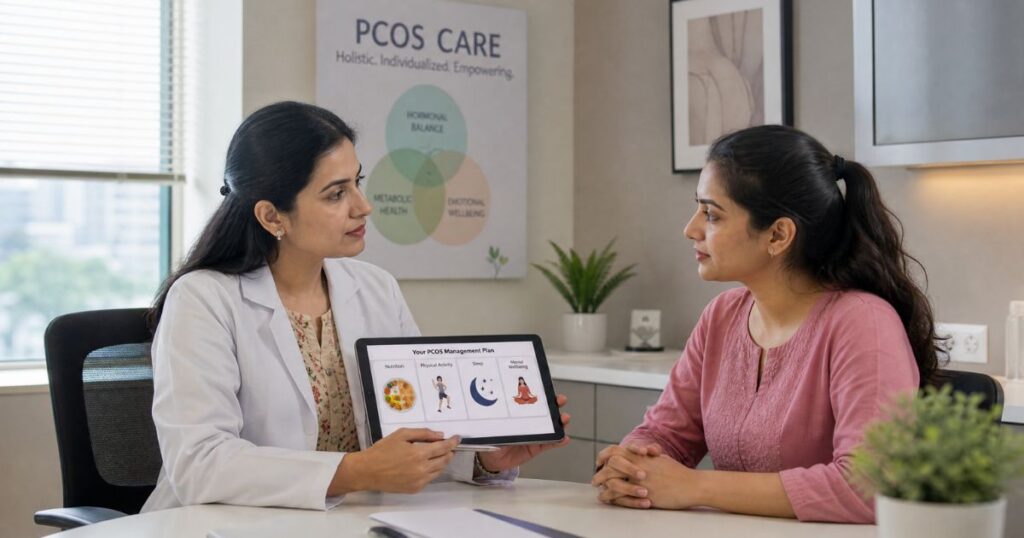
A healthy lifestyle — balanced nutrition, regular physical activity, adequate sleep and stress management — is the recommended starting point for everyone with PCOS. For women carrying excess weight, even a modest 5–10% reduction in body weight has been shown to improve many features of PCOS, including cycle regularity and metabolic markers [7]. Crucially, the guideline is clear that there are benefits to a healthy lifestyle even without weight loss, and it emphasises avoiding weight stigma [1]. In other words, the goal is health-supporting habits, not a number on a scale.
Medical options (decided with your doctor)
Several evidence-based medical options exist, and which — if any — is appropriate is a decision for your treating doctor, based on your symptoms and priorities. The 2023 guideline describes the following broad roles [1][3]:
- Combined oral contraceptive pills are a first-line option a doctor may consider for managing menstrual irregularity and hyperandrogenism (acne, excess hair).
- Metformin is used mainly for metabolic features and, per the guideline, has greater efficacy than inositol for these outcomes.
- Inositol supplements are widely used and generally well tolerated, though the guideline notes their clinical benefits appear limited.
- Anti-androgen medicines and cosmetic options such as laser hair reduction may have a role for hirsutism in specific situations.
This is a map of what exists, not a prescription. Please do not start, stop, or change any medication or supplement based on an article — that is a conversation to have with your gynaecologist or endocrinologist.
Mental and emotional health
PCOS is not “just” physical. The 2023 guideline highlights a high prevalence of psychological features, including anxiety and depression, and recommends that emotional wellbeing be part of routine care [3][6]. If you are struggling with mood, body image, or the emotional weight of managing a chronic condition, that is a valid part of your health to raise with your doctor — not something to push aside.
Fertility
For women trying to conceive, PCOS is one of the most common and treatable causes of difficulty getting pregnant. Lifestyle measures form the base, and where medical help is needed, ovulation-induction options exist and are effective for many women [3]. The important messages are that PCOS does not mean infertility for most women, and that fertility care should be individualised — so early, honest conversations with a specialist are worthwhile if you are planning a pregnancy.
Long-term health, and why monitoring matters
Beyond periods and fertility, PCOS is linked with several longer-term health considerations, which is why ongoing monitoring — not one-time treatment — is the sensible approach [8][9]:
- Type 2 diabetes and metabolic syndrome, linked to insulin resistance.
- Higher risk of raised cholesterol, blood pressure, and non-alcoholic fatty liver disease.
- Obstructive sleep apnoea in some women.
- Endometrial (uterine lining) considerations: when periods are very infrequent for long stretches, the lining can build up without regular shedding, which over years can raise endometrial risk — one reason doctors care about restoring some cycle regularity.
- Pregnancy considerations, such as a higher chance of gestational diabetes, which is manageable with good antenatal care.
None of this is a reason to panic. It is a reason to stay engaged with your health — periodic checks of blood sugar, blood pressure, and lipids, and keeping an eye on cycle patterns, mean problems are caught early when they are easiest to address.
PCOS in India — what’s worth knowing
PCOS is common among Indian women, but you will see very different prevalence figures quoted, ranging widely depending on the diagnostic criteria used and the population studied. That variability is real and international — reported prevalence globally spans a broad range for the same reason. Rather than trust any single dramatic “1 in X Indian women” headline, it is more accurate to say PCOS is common and under-diagnosed here.
The Indian Council of Medical Research (ICMR) established a dedicated PCOS Task Force to study prevalence, regional variation, comorbidities and treatment response across the country — among the first nationally representative efforts of its kind [6]. Work from this and related Indian research points to meaningful regional and phenotypic variation, and to metabolic risk factors that make screening and early lifestyle support particularly worthwhile in the Indian context.
Practically, if you are in India and suspect PCOS, the encouraging news is that awareness, diagnostics and specialist care are increasingly accessible — and the earlier you engage, the more options you have.
When to see a gynaecologist or endocrinologist
Consider booking an appointment if you notice:
- Periods that are consistently irregular, very infrequent, or absent for several months (and you are not pregnant).
- Signs of excess androgens — new or worsening facial/body hair, persistent acne, or scalp hair thinning.
- Difficulty conceiving after trying for a reasonable period.
- Metabolic warning signs such as unexplained weight changes, the darkened skin patches described earlier, or a family history of diabetes.
- Low mood, anxiety, or distress about any of the above.
A gynaecologist is a sensible first stop; an endocrinologist may be involved where hormonal or metabolic features are prominent. Seek prompt medical attention for anything that feels acutely wrong — for example, severe pelvic pain or very heavy bleeding — rather than assuming it is “just PCOS.”
Frequently asked questions
Q1. Is PCOS the same as PCOD?
In everyday Indian usage the terms are often used interchangeably. The internationally recognised clinical term is PCOS, which is what current guidelines use.
Q2. Can PCOS be cured?
There is no cure, but PCOS can usually be managed well. Lifestyle measures and, where appropriate, medical care can improve symptoms and protect long-term health. Be cautious of anything promising a “cure.”
Q3. Can I get pregnant if I have PCOS?
Many women with PCOS do conceive. PCOS is a common but often treatable cause of difficulty conceiving. If you are planning a pregnancy, an early conversation with a specialist is helpful.
Q4. Can you have PCOS if you are not overweight?
Yes. Lean PCOS is well recognised — you can meet the diagnostic criteria at a normal body weight, and it is often diagnosed late for exactly this reason.
Q4. Do I need an ultrasound to be diagnosed?
Not always. In adults, if both irregular cycles and hyperandrogenism are present, an ultrasound or AMH test may not be needed. In adolescents, ultrasound and AMH are not recommended for diagnosis.
Q5. Is PCOS dangerous long-term?
It is linked with longer-term risks such as type 2 diabetes and metabolic issues, which is why monitoring matters — but these risks are manageable, and early engagement makes a real difference.
Q6. Does PCOS affect mental health?
It can. Anxiety and depression are more common in women with PCOS, and emotional wellbeing is a legitimate and important part of care.