
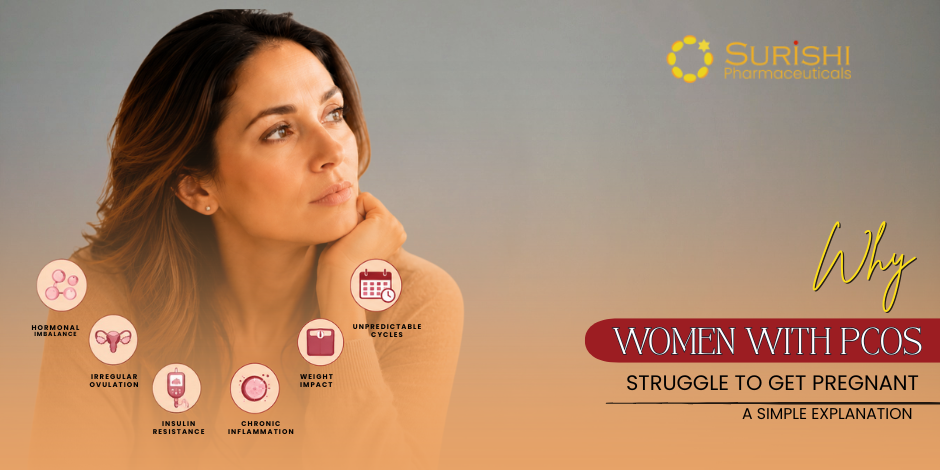
PCOS, Polycystic Ovary Syndrome, affects roughly 1 in 5 women in India. It is the single most common cause of ovulatory infertility. Yet most women diagnosed with PCOS are told what it is without being clearly told why it makes getting pregnant harder.
This blog explains exactly what PCOS does to the reproductive system in plain language and what women with PCOS can realistically do about it.
What PCOS Actually Is
Despite the name, PCOS is not primarily a condition of the ovaries. It is a metabolic and hormonal disorder that affects the entire body, and the ovaries are where its effects on fertility show up most clearly.
Under normal physiological conditions, the brain signals the ovaries to drive the complete ovulation process, whereas polycystic ovary syndrome causes failures at multiple nodes in this process.
1. High LH levels:
Excess luteinising hormone disrupts normal follicle development and egg maturation.
2. Insulin resistance:
Elevated insulin levels stimulate the ovaries to produce excess androgens (male hormones), thereby interfering with ovulation.
3. Elevated androgens:
High concentrations of testosterone and DHEA inhibit normal follicular maturation; once development stalls and follicles accumulate, they eventually form PCOS-related ovarian cysts.
4. Irregular or absent ovulation:
Without regular ovulation, there is no egg available to fertilize, making natural conception significantly harder.
The Egg Quality Problem Nobody Talks About
Most women with PCOS are told they have plenty of follicles, and that is true. What they are rarely told is that having more follicles does not mean having better eggs.PCOS creates conditions that actively compromise egg quality in several ways:
1. Oxidative stress:
Excess free radicals in the bodies of patients with polycystic ovary syndrome can damage the DNA and cellular structures of mature oocytes.
2. Mitochondrial dysfunction:
Mitochondria provide energy for the entire process of oocyte maturation and fertilization. A pathological environment characterised by hyperandrogenism and hyperinsulinemia leads to a functional decline in these organelles.
3. Slow maturation:
Women with polycystic ovary syndrome (PCOS) exhibit asynchronous maturation of oocytes within their ovarian follicles, which increases the incidence of chromosomal errors and significantly elevates the risk of abnormal fertilization.
4. Poor follicular fluid quality:
Patients with polycystic ovary syndrome have poor-quality follicular fluid, which reflects the hormonal and metabolic internal environment within their bodies. This fluid carries higher levels of androgens and inflammatory markers.
This phenomenon is why two women with the same number of follicles can have very different pregnancy outcomes and why addressing egg quality, not just ovulation, is central to fertility care in PCOS.
Why IVF Is Not Always the First Answer
Women with PCOS are sometimes moved to IVF quickly because ovulation induction has not worked. But if egg quality has not been addressed, retrieving more eggs does not automatically lead to better embryos.
PCOS patients are actually at risk of ovarian hyperstimulation syndrome (OHSS), a serious complication of IVF, precisely because they produce so many follicles in response to stimulation. This makes preconception preparation, rather than immediate assisted reproduction, the preferred starting point in numerous instances.
A structured 90-day mitochondrial support protocol before any fertility treatment can significantly improve the quality of eggs available and reduce the number of cycles needed. MITOV is India’s first mitochondrial optimizer for female fertility.
It is suitable for people with PCOS and ovulatory dysfunction. The product contains four core ingredients, including NMN and CoQ10, which respectively deliver four key benefits: replenishing NAD+, boosting oocyte energy, providing antioxidant protection, and reducing cellular inflammation.
What Actually Helps Women with PCOS Conceive
There is no single solution for PCOS-related infertility, but there is a clear set of strategies that work together:
1. Weight management:
Even a 5 to 10 percent reduction in body weight can restore ovulation in overweight women with PCOS.
2. Blood sugar control:
Reducing refined carbohydrates and managing insulin resistance improves the hormonal environment of the ovary.
3. Mitochondrial support:
Targeted supplementation with NMN, CoQ10, and antioxidants like Astaxanthin improves oocyte energy and reduces oxidative damage.
4. Ovulation induction:
Medications like letrozole or clomiphene can trigger ovulation when lifestyle changes alone are insufficient.
5. Pre-IVF preparation:
If IVF is needed, a 90-day preparation protocol with mitochondrial support maximises egg quality before retrieval.
The Emotional Side of PCOS and Infertility
PCOS-related infertility is particularly challenging to navigate because the condition is invisible to most people around you, the timeline is unpredictable, and the fertility journey often feels like a series of failed attempts with no clear endpoint.
What helps most, beyond the clinical, is having a clear plan and knowing what you are doing, why you are doing it, and what timeframe to expect. The 90-day egg maturation window is the plan. It is finite, it is evidence-based, and it gives you something concrete to do right now.
The Bottom Line
PCOS makes conception harder, but it does not make it impossible. The hormonal disruption it causes affects both ovulation and egg quality, which is why treating PCOS for fertility requires more than just triggering ovulation.
Addressing the cellular environment in which your eggs are developing through mitochondrial support, oxidative stress reduction, and metabolic management is as important as any medication.
Start the conversation with your doctor about preconception preparation. The 90 days between now and your next cycle are not empty time. Use them.
Frequently Asked Questions
Can women with PCOS get pregnant naturally?
Most women with PCOS can conceive naturally. This outcome is particularly achievable if they properly implement three types of interventions, including lifestyle modification, whose core goals are to restore regular ovulation and improve egg quality.
Why does PCOS affect egg quality?
The three types of pathological abnormalities triggered by polycystic ovary syndrome (PCOS) all impede oocyte maturation and increase the risk of chromosomal errors occurring during the fertilization stage.
How does MITOV help women with PCOS trying to conceive?
MITOV is specifically designed for use in PCOS (Polycystic Ovary Syndrome) and ovulatory dysfunction. It exerts three core therapeutic effects: supporting oocyte mitochondrial function, reducing oxidative stress, and counteracting inflammation, and it delivers these effects via its active ingredients astaxanthin and trans-resveratrol.
Does losing weight really help PCOS fertility?
Women diagnosed with polycystic ovary syndrome only need to lose 5% to 10% of their body weight to lower their insulin levels, improve their ovarian hormonal environment, and successfully restore ovulation.
Should I consider IVF for infertility caused by PCOS?
Many people mistakenly believe that in vitro fertilization (IVF) is the first-line treatment option for infertility in women with PCOS. Most patients respond well to ovulation induction combined with pre-pregnancy preparation, and IVF is only used when all other treatment approaches have failed.
How long does it take to improve egg quality with PCOS?
Eggs take 90 days to mature. A structured preparation protocol that starts at least 3 months before your planned conception attempt or IVF cycle yields the best results.
(Message in Public Interest by Surishi Academic Council | Makers of MITOV)