
If you are going through IVF, your clinic has almost certainly prescribed progesterone for the days after your embryo transfer. This is called luteal phase support (or “LPS”), and here is the short answer to why it matters. The luteal phase is the second half of the cycle, after ovulation, when the body normally produces progesterone to keep the womb lining ready for a pregnancy. In an IVF cycle, that natural progesterone-making machinery is disrupted by the medicines used to grow and collect eggs — so doctors supplement progesterone to give the embryo the best chance to implant and the early pregnancy the support it needs.
In other words, luteal phase support in IVF is a standard, expected part of treatment — not a sign that something is wrong. This article explains why the luteal phase needs help after IVF, why progesterone is the mainstay, how the different forms and timings work at a high level, what the evidence actually shows, and the practical questions worth asking your fertility team. It is educational only; your clinic decides the exact medicine, route, dose and duration for you.
Why the luteal phase needs support after IVF
In a natural cycle, ovulation leaves behind a temporary gland called the corpus luteum, which pumps out progesterone to transform the womb lining into a receptive, nourishing surface and to sustain a pregnancy in its earliest weeks. IVF disturbs this in a few ways:
- The hormone medicines used to grow many eggs create very high steroid levels, which signal the brain to switch off the natural hormones (LH) that keep the corpus luteum working.
- The medicines used to prevent premature ovulation (GnRH agonists or antagonists) further suppress those signals.
- During egg collection, some of the cells that would have formed and supported the corpus luteum are removed along with the eggs.
The result is a luteal phase deficiency — the body cannot reliably make enough progesterone at the crucial implantation window. Supplementing progesterone corrects for this, which is why it has become a routine, evidence-based part of IVF and ICSI care.
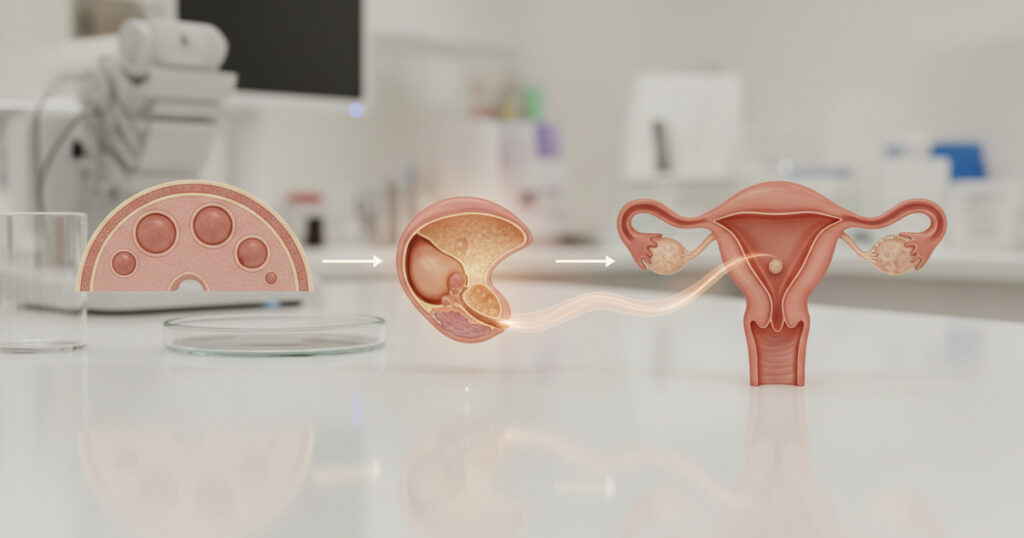
What luteal phase support actually is
Luteal phase support means giving medication after egg retrieval or embryo transfer to keep the womb lining receptive and support early implantation. Progesterone is the mainstay, because it is the hormone directly responsible for preparing and maintaining the lining. Historically, doctors also used hCG (a hormone that props up the corpus luteum) or GnRH agonists, but hCG carries a higher risk of ovarian hyperstimulation syndrome (OHSS) without clearly outperforming progesterone, so progesterone is generally preferred. Some cycles add a little oestrogen, and some specific situations use extra LH-type support — but for most patients, progesterone is the core of luteal support.
Fresh versus frozen transfer — why it changes things
How much your own body can contribute depends on the type of cycle, and this is an area of active research:
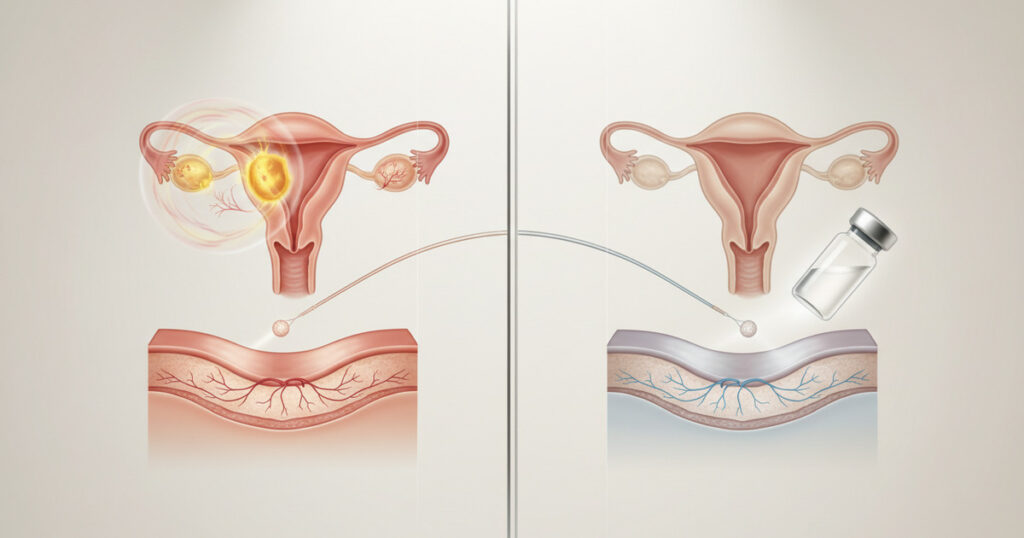
- In a fresh transfer, one or more corpora lutea exist after egg collection, but their function is impaired by stimulation — so progesterone support is given to make up the shortfall.
- In a programmed (medicated/HRT) frozen transfer, the ovaries are kept quiet and there is no corpus luteum at all. Here, supplemental progesterone is the only source the pregnancy has until the placenta takes over, so it is absolutely essential and cannot be skipped or stopped early.
- In a natural-cycle frozen transfer, ovulation does occur and a corpus luteum forms, but its output is not always adequate, so many clinics still add progesterone.
A newer development is that some clinics measure serum progesterone around the time of transfer, because levels below roughly the mid-range have been linked to lower live-birth rates in frozen cycles. Where levels are low, adding extra progesterone (a “rescue” approach) may help restore outcomes. This is an evolving area, and practice varies — another reason your specific plan is individualised.
Routes of progesterone: vaginal, injectable and oral
Progesterone can be given by different routes, each with trade-offs. There is no single route that is universally best — the right choice depends on the protocol, absorption, cost and, importantly, what you can comfortably keep up throughout the wait.
| Route | How it works / pros | Trade-offs |
|---|---|---|
| Vaginal | Acts close to the uterus and avoids heavy liver processing; the most commonly used route worldwide; no injections | Discharge, local irritation or itching; multiple daily applications |
| Injectable (IM/SC) | Reliable blood levels; sometimes used when a stronger or measurable effect is wanted | Injection-site pain, swelling or lumps (IM); daily injections are burdensome |
| Oral | Convenient tablets; oral dydrogesterone has good absorption and is increasingly used for luteal support | Oral micronised progesterone is heavily broken down and can cause drowsiness, so it is less favoured for this specific purpose |
Many clinics use vaginal progesterone as the default, some use injections or a combination, and oral dydrogesterone has emerged as a well-tolerated option shown to work comparably for luteal support in IVF. Your clinic will pick what fits your cycle.
Timing and duration — when it starts and stops
Timing matters. Research suggests there is a window for starting progesterone — roughly from the evening after egg retrieval up to a few days later — with starting too early (before retrieval) or too late linked to lower pregnancy rates. Most clinics begin around the day of, or day after, egg collection in fresh cycles, and at a defined point before a frozen transfer so the lining and embryo are in step.
As for how long: if the pregnancy test is negative, progesterone is stopped. If it is positive, it is usually continued into early pregnancy — commonly until around 8 to 10 weeks, when the placenta takes over hormone production (the “luteoplacental shift”). Some clinics continue to about 12 weeks, though evidence for going that long is limited, and practice genuinely varies between centres. The key point for you: follow your clinic’s schedule exactly and never stop or change progesterone on your own — stopping too soon, especially in a medicated frozen cycle, can be harmful.
What the evidence shows
A large Cochrane review of luteal phase support in assisted reproduction found that progesterone support improves pregnancy outcomes compared with no support, and that progesterone is generally preferred over hCG (which adds OHSS risk without clear benefit). Importantly, the review did not crown a single “best” progesterone, route or protocol — the different approaches each have reasonable evidence, and results depend on the cycle and the individual. Large trials have also shown oral dydrogesterone to be a comparable alternative to vaginal progesterone for IVF luteal support.
So the honest summary is: luteal phase support with progesterone clearly helps in IVF, but the ideal agent, route, dose and duration remain debated, and reputable clinics differ. This is normal, and it is why guidelines emphasise individualised care over a one-size-fits-all recipe.
| A note on protocol variation If a friend’s IVF progesterone plan looks different from yours — a different medicine, route, or stop date — that does not mean one clinic is wrong. Because the evidence supports several reasonable approaches, protocols legitimately vary between doctors and between fresh and frozen cycles. What matters is following your own clinic’s plan consistently, not matching someone else’s. |
Side effects and what’s normal
Progesterone for luteal support is generally well tolerated, and side effects depend on the route. Vaginal preparations can cause discharge, irritation or itching. Injections can cause soreness, swelling or lumps at the site. Oral progesterone can cause drowsiness or dizziness. More generally, progesterone can bring bloating, breast tenderness, mild mood changes, and tiredness.
Here is a reassuring but important point for the two-week wait: many progesterone side effects — sore breasts, bloating, fatigue, mild cramping, spotting — overlap with both early-pregnancy signs and pre-period signs. That means symptoms (or the absence of them) cannot tell you whether the cycle has worked. Only the blood pregnancy test, at the time your clinic schedules it, can do that. Try not to read the outcome into how you feel.
Questions worth asking your fertility clinic
- Which progesterone (or dydrogesterone) am I on, by which route, and why is it right for my cycle?
- Exactly when do I start, and until when do I continue if the test is positive?
- What should I do if I miss a dose or a dose comes back out (with vaginal use)?
- Will you check my serum progesterone level, and could my support be adjusted if it is low?
- Which side effects are expected, and which ones should prompt me to call you?
- Is any oestrogen or additional medicine part of my plan, and how do I take everything together?
Where Surishi’s products fit
Surishi’s gynaecology and pregnancy range includes progestogen products used in women’s fertility and pregnancy care — for example, the progesterone line SU-PREG-200 and SU-PREG-300-SR, and the dydrogesterone product SUDYDRO. These are shared here only as portfolio examples. Which agent, route, dose and duration are appropriate for luteal support in any given IVF or frozen-transfer cycle is a decision only your fertility specialist can make — so this article does not recommend any specific product, imply one is best, or promise any outcome. You can see current details on the product pages, and any questions about a specific formulation are best directed to your treating doctor or to Surishi’s team.
When to seek medical care
- Severe abdominal bloating, rapid weight gain, breathlessness, reduced urination or intense pain after egg retrieval — these can signal OHSS and need urgent review.
- Heavy vaginal bleeding, severe or one-sided pain, dizziness or fainting — seek care promptly, including to rule out ectopic pregnancy after a positive test.
- A missed dose, a reaction to a medicine, or uncertainty about your schedule — call your clinic rather than guessing or stopping.
- Any symptom that worries you during the two-week wait — your clinic would rather you asked than worried alone.
| Medical disclaimer This article is for general education only and is not a substitute for professional medical advice, diagnosis or treatment. It does not diagnose any condition, promise any fertility outcome, provide a dosing protocol, or recommend a personal treatment plan. Progesterone and related medicines are prescription-only — do not start, stop, or change them, or any other medicine, based on this content. Always follow your fertility clinic’s instructions and consult your treating doctor about your individual cycle. |
FAQs :
Q1. What is luteal phase support in IVF?
It is the medication — usually progesterone — given after egg retrieval or embryo transfer to keep the womb lining receptive and support early implantation. IVF medicines disrupt the body’s natural progesterone production, so supplementation makes up the shortfall. It is a standard, expected part of treatment.
Q2. Why is progesterone used after embryo transfer?
Progesterone is the hormone that prepares and maintains the womb lining for an embryo. After IVF, the ovaries cannot reliably produce enough of it at the implantation window, so it is supplemented to give the embryo the best chance to implant and the early pregnancy the support it needs.
Q3. Which is better — vaginal, injectable or oral progesterone?
There is no single best route for everyone. Vaginal progesterone is the most widely used; injections give reliable blood levels but are uncomfortable; oral dydrogesterone is a well-tolerated tablet option. The right choice depends on your protocol, absorption and what you can keep up — your clinic decides.
Q4. When do I start and stop progesterone in an IVF cycle?
Timing is individualised. Progesterone is generally started around egg retrieval in fresh cycles, or at a set point before a frozen transfer. If the test is positive it is usually continued into early pregnancy — often to about 8–10 weeks — but this varies by clinic. Follow your clinic’s schedule and never stop on your own.
Q5. Do frozen embryo transfers need progesterone too?
Yes, and often more critically. In a medicated (HRT) frozen cycle there is no corpus luteum at all, so supplemental progesterone is the pregnancy’s only source until the placenta takes over — it must not be skipped or stopped early. Natural-cycle frozen transfers may also use progesterone.
Q6. What are the side effects of progesterone support?
They depend on the route: vaginal forms can cause discharge or irritation, injections can cause site soreness, and oral forms can cause drowsiness. Bloating, breast tenderness and tiredness are common. Importantly, these overlap with early-pregnancy and pre-period symptoms, so they cannot tell you whether the cycle worked.
Q7. Can progesterone side effects tell me if IVF worked?
No. Symptoms during the two-week wait — sore breasts, bloating, spotting, cramping — occur with progesterone whether or not you are pregnant, and their absence does not mean failure. Only the blood pregnancy test, taken when your clinic schedules it, can confirm the result.