
An off-schedule period can be unsettling — but on its own, an irregular cycle is common and often has a simple, treatable explanation. This guide maps the usual causes, separates the ordinary from the concerning, and — most importantly — tells you the warning signs that mean it is time to see a doctor.
The short answer
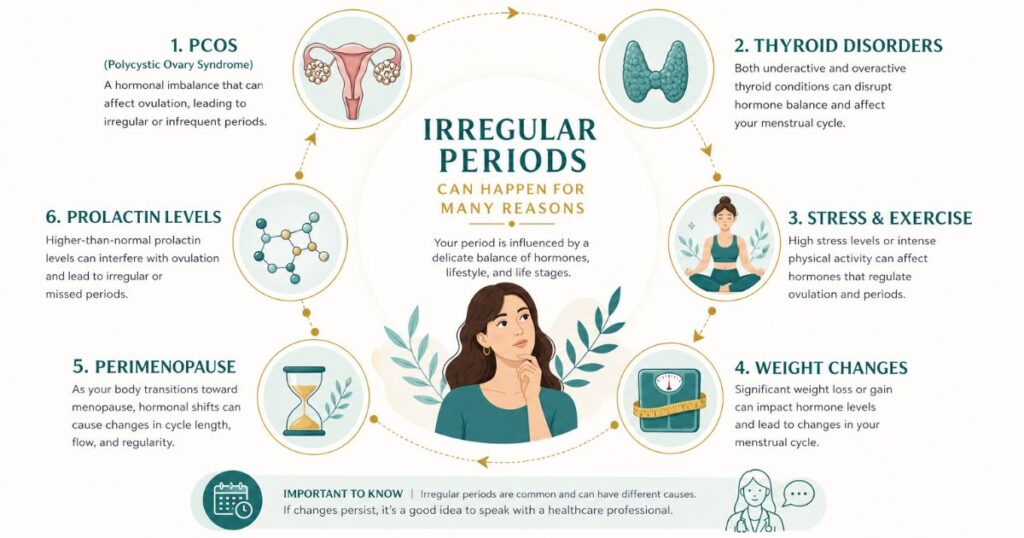
Irregular periods have many possible causes, and “hormonal imbalance” is only one of them. The common ones include pregnancy, polycystic ovary syndrome (PCOS), thyroid problems, raised prolactin (a pituitary hormone), the natural transition of perimenopause, the early years after a first period, and lifestyle-related shifts such as significant stress, weight change, intense exercise or under-eating. Certain medicines can also change your cycle. Many of these are manageable once identified. What matters is not to self-diagnose, but to notice the pattern and know when it needs a doctor — especially if bleeding is very heavy, happens between periods or after sex, lasts more than 7–8 days, or if you have gone more than three months without a period and could be pregnant.
The rest of this guide walks through each cause in plain language, gives you a quick symptom-to-cause orientation, and lists the red flags that deserve prompt medical attention.
What a “normal” cycle looks like — and what counts as irregular
Your menstrual cycle is counted from the first day of one period to the first day of the next. Medical bodies (FIGO and ACOG) describe a typical cycle using four features: how often it comes, how regular it is, how long bleeding lasts, and how heavy it is.
- Frequency : a normal cycle usually arrives every 24 to 38 days.
- Regularity : cycle length that varies only a little month to month (roughly within a week) is considered regular.
- Duration : bleeding typically lasts about 2 to 7 days.
- Volume : flow that does not soak through protection every hour or pass very large clots.
So “irregular” generally means cycles shorter than about 24 days or longer than about 38 days, marked variation from one cycle to the next, missed periods, bleeding that lasts too long, or flow that is much heavier or lighter than usual. A single unusual month is rarely a worry; a persistent pattern is worth understanding. It is also completely normal for cycles to be irregular in the first couple of years after periods begin and again during the years approaching menopause — both are times of natural hormonal change.
Why “hormonal imbalance” isn’t the whole story
“Hormonal imbalance” is a popular phrase, but it is a description, not a diagnosis — and it is not the cause in every case. Doctors think about irregular bleeding more precisely, using an international framework (called PALM-COEIN) that sorts causes into two groups: structural ones you could see on a scan — such as polyps, fibroids, adenomyosis, or, rarely, pre-cancerous or cancerous changes — and non-structural ones such as ovulation problems (as in PCOS), thyroid or prolactin issues, bleeding-clotting disorders, the lining of the womb itself, and the effects of medicines. Pregnancy sits outside this framework and is always considered first. The point is simple: the right help depends on the actual cause, so the goal is to find out which one — not to assume.
Common causes of irregular periods
Pregnancy — always the first thing to rule out
A missed or unusual period in anyone who could be pregnant should prompt a pregnancy test. It is the single most important thing to exclude before looking further, whatever your age, because it changes everything about what to do next.
Polycystic ovary syndrome (PCOS)
PCOS is one of the most common reasons for irregular or infrequent periods in women of reproductive age. It involves a disruption of ovulation, so cycles become unpredictable or widely spaced. It is often accompanied by signs of higher androgen levels — such as acne or extra facial or body hair — and is frequently linked with insulin resistance. If your cycles are long or erratic alongside these features, PCOS is worth discussing with a doctor. (You can read more in our companion articles on PCOS and pregnancy and PCOS-friendly eating.)
Thyroid disorders
The thyroid gland helps regulate the menstrual cycle, so both an underactive thyroid (hypothyroidism) and an overactive one (hyperthyroidism) can disturb periods. An underactive thyroid commonly causes infrequent or absent periods and can interfere with ovulation; it can also raise prolactin. An overactive thyroid tends to make periods lighter or less frequent. Thyroid problems are common in Indian women and are checked with a simple blood test, so they are often part of an irregular-period work-up.
Raised prolactin (hyperprolactinaemia)
Prolactin is a hormone from the pituitary gland. When it is higher than normal, it can suppress ovulation and cause irregular or absent periods. Only about a third of women with raised prolactin have milky nipple discharge, so its absence does not rule it out. Causes range from an underactive thyroid and certain medicines to a small, usually benign pituitary growth. A blood test can check prolactin, and it is generally assessed alongside thyroid function.
Stress, weight change, intense exercise and low energy
The brain’s control of the cycle is sensitive to your overall energy balance and stress load. Significant psychological stress, rapid weight loss or gain, very intense exercise, or simply not eating enough to match your activity can quieten the hormonal signal that drives ovulation — a state doctors call functional hypothalamic amenorrhoea. Periods may become infrequent or stop. This is the body’s way of pausing reproduction when it senses scarcity or strain. If this may apply to you, it deserves gentle, proper attention rather than pushing harder: under-fuelling and over-exercising can affect bone and heart health over time, and support is available. If you are struggling with food, exercise or your body image, please reach out to a doctor — this is common and treatable, and you deserve help.
Perimenopause
In the years leading up to menopause — often the 40s, but sometimes the mid-30s or 50s — hormone levels fluctuate and ovulation becomes less predictable. A change in your cycle is usually the first sign: periods may space out, come closer, or vary in flow, and you may skip some. This transition lasts around four years on average and is a normal phase of life. That said, bleeding that returns after a full year with no periods (postmenopausal bleeding) always needs prompt medical assessment.
The first years after periods begin
For a year or two after a first period, cycles are commonly irregular because the hormonal system is still maturing. This is usually normal. Still, very heavy bleeding, periods that are extremely painful, or cycles that remain very irregular well beyond this window are worth a check — sometimes conditions like PCOS or thyroid issues first show up here.
Medicines and contraception
Some medicines and contraceptives change bleeding patterns — this is common and often expected. Hormonal contraception (pills, injections, implants, hormonal IUDs) can make periods lighter, irregular, or absent; starting or stopping them can cause a temporary shift. Certain other drugs, including some used for mental health, nausea, or other conditions, can also affect the cycle. Never start, stop or change a prescribed medicine on your own — if you think a medicine is affecting your periods, discuss it with the doctor who prescribed it.
Structural and other causes
Sometimes the cause is physical or systemic: fibroids (benign muscle growths in the womb), polyps, adenomyosis (womb-lining tissue within the muscle), or, less commonly, a bleeding/clotting disorder or primary ovarian insufficiency (when ovaries reduce function before 40). Endometriosis can cause painful, heavy or irregular bleeding. These are diagnosed through examination, scans and blood tests, which is exactly why a persistent change is worth investigating rather than guessing.
A quick symptom-to-cause orientation
This is a rough guide to help you frame a conversation with your doctor — not a way to diagnose yourself. Several causes can overlap, and only a clinician can confirm what is going on.
| What you’re noticing | Causes worth discussing |
|---|---|
| Long or widely spaced cycles + acne or extra hair | PCOS; sometimes thyroid or raised prolactin |
| Infrequent/absent periods + tiredness, weight or temperature changes | Thyroid disorder |
| Absent periods ± milky nipple discharge, headaches | Raised prolactin |
| Periods stopped after stress, weight loss or heavy training | Functional hypothalamic (low-energy) cause |
| Cycle changes in your 40s ± hot flushes, sleep changes | Perimenopause |
| Missed period and pregnancy is possible | Pregnancy — test first |
| Very heavy or prolonged bleeding, clots, pain | Structural causes (fibroids, polyps, adenomyosis) or a bleeding disorder |
Red flags — when to see a doctor promptly
Please seek medical care if you have any of the following :
- Very heavy bleeding — soaking through a pad or tampon every hour for two or more hours, or passing clots larger than a coin.
- Bleeding that lasts longer than about 7–8 days.
- Bleeding between periods, after sex, or any bleeding after menopause.
- No period for three months or more when you are not pregnant.
- A missed period when pregnancy is possible — take a test and seek care.
- Cycles consistently shorter than 21–24 days or longer than 35–38 days.
- Severe pelvic pain, fever, or foul-smelling discharge.
- Signs of anaemia from blood loss — unusual tiredness, breathlessness, dizziness or fainting.
- A sudden, marked change from periods that were previously regular.
If bleeding is extremely heavy with dizziness or fainting, treat it as urgent and seek immediate care. Otherwise, a non-urgent appointment to investigate a persistent change is always reasonable — you do not need to wait for things to get worse.
How a doctor evaluates irregular periods
Understanding the process can make an appointment feel less daunting. A doctor will usually start with your history — your cycle pattern, other symptoms, medicines, and whether pregnancy is possible — and an examination. Depending on what they find, they may arrange :

- A pregnancy test.
- Blood tests — commonly thyroid function and prolactin, and hormone or androgen tests if PCOS is suspected.
- A pelvic ultrasound to look at the uterus and ovaries.
- Occasionally, further tests such as assessment of the womb lining, especially with heavy or persistent bleeding or in older women.
Treatment then depends entirely on the cause — which is why there is no single “period-regulating” fix that suits everyone. Options a clinician might consider range from managing an underlying thyroid or prolactin issue, to lifestyle support, to hormonal or non-hormonal medicines or a procedure for structural causes. Any prescription treatment should be chosen and monitored by your doctor.
Tracking your cycle helps
Whatever the cause, a simple record is genuinely useful. Note the start and end dates of each period, how heavy the flow is, and any other symptoms (pain, mood changes, discharge, hot flushes). A period-tracking app or a notebook both work. Bringing this to your appointment helps your doctor see the pattern quickly and reach the right answer sooner.
The bottom line
Irregular periods are common and usually explainable — from PCOS, thyroid or prolactin issues to stress, weight and energy changes, perimenopause, or simply the years around your first period. “Hormonal imbalance” is sometimes involved, but not always, and the right help depends on finding the real cause. Track your cycle, notice the pattern, act on the red flags, and see a doctor for anything persistent or worrying. Most causes are manageable once identified — and getting answers is easier than living with the uncertainty.
FAQs :
Q1. What is considered an irregular period?
A cycle is generally considered irregular if it comes less than about 24 days or more than about 38 days apart, varies a lot from month to month, involves missed periods, lasts longer than 7–8 days, or is much heavier or lighter than usual. A single unusual month is rarely a concern; a persistent pattern is worth checking.
Q2. What are the most common causes of irregular periods?
Common causes include pregnancy, PCOS, thyroid disorders, raised prolactin, perimenopause, the first years after periods begin, and lifestyle factors such as significant stress, weight change, intense exercise or under-eating. Some medicines and contraceptives can also change the cycle.
Q3. Are irregular periods always caused by a hormonal imbalance?
No. “Hormonal imbalance” is one possibility, not the answer in every case. Causes can also be structural (such as fibroids or polyps), related to thyroid or prolactin, lifestyle-related, or due to medicines. Pregnancy is always considered first. The right help depends on the actual cause.
Q4. When should I see a doctor about irregular periods?
Seek care if bleeding is very heavy (soaking a pad or tampon every hour for 2+ hours) or has large clots, lasts more than 7–8 days, happens between periods or after sex, occurs after menopause, or if you have gone three or more months without a period when not pregnant. Also see a doctor for cycles consistently under 21 or over 35–38 days, severe pain, or signs of anaemia.
Q5. Can stress cause irregular periods?
Yes. Significant psychological stress, rapid weight change, very intense exercise, or not eating enough can quieten the hormonal signals that drive ovulation, making periods infrequent or absent. This is common and treatable; if it may apply to you, it is worth discussing with a doctor rather than pushing through.
Q6. Are irregular periods normal during teenage years and perimenopause?
Often, yes. Cycles are commonly irregular in the first year or two after periods begin and again in the years approaching menopause, because hormone levels are naturally changing. Even so, very heavy bleeding, severe pain, or bleeding after menopause should always be checked.
Q7. Can thyroid problems affect my periods?
Yes. Both an underactive and an overactive thyroid can disturb the cycle — an underactive thyroid often causes infrequent or absent periods, while an overactive one can make them lighter or less frequent. A simple blood test can check thyroid function.
Q8. Do irregular periods mean I can’t get pregnant?
Not necessarily. Irregular periods can make ovulation less predictable, which may make conception take longer, but many women with irregular cycles conceive — sometimes naturally, sometimes with help. If you are trying to conceive with irregular cycles, a doctor can check whether and when you are ovulating.