
If you have PCOS and have gone looking for “the right diet,” you have probably been told to give up rice, quit roti, go gluten-free, drop dairy, and never touch a banana again. It is confusing, joyless, and mostly unnecessary. This guide offers something calmer and more practical: a realistic way to eat everyday Indian food that supports your hormones — without a crash diet.
The short answer
There is no single “PCOS diet.” What genuinely helps is a steady, balanced eating pattern rather than any one magic food or strict elimination. For a PCOS diet for Indian women, that usually means: build most meals around vegetables, good protein (dal, curd, paneer, eggs, fish, chicken) and fibre; choose slower-digesting carbohydrates (millets, whole-wheat roti, brown or hand-pounded rice in sensible portions) over refined ones (maida, white bread, sugary drinks); include healthy fats; and keep the overall pattern consistent. National and international guidelines are clear that no single diet is proven superior for PCOS — so the goal is a nourishing, sustainable pattern you can actually keep, not perfection or punishment.
The rest of this guide turns that principle into your real kitchen: the balanced plate, the truth about rice and roti, vegetarian and non-vegetarian options, a flexible day of meals, festivals and eating out, and honest answers on sugar, dairy, gluten and soy.
Why Food Matters in PCOS : The Insulin Link
PCOS is a common hormonal condition — the World Health Organization estimates it affects roughly 8–13% of women of reproductive age, and Indian studies suggest around 1 in 9 adult women. For a large share of women with PCOS, including many who are not overweight, a key driver is insulin resistance: the body’s cells respond less well to insulin, so the pancreas makes more of it.
Here is why that connects to your plate. When you eat foods that raise blood sugar quickly, insulin rises sharply to manage it. Persistently high insulin can nudge the ovaries toward producing more androgens (“male-type” hormones), which can worsen irregular cycles, acne and unwanted hair. Choosing foods that release sugar more slowly, and pairing carbohydrates with protein, fibre and fat, helps keep this response steadier. This is the logic behind most sensible PCOS eating — not that any single food is “toxic,” but that the overall pattern shapes how hard your body has to work.
A quick note on terminology: some professional bodies have proposed renaming PCOS to better reflect its metabolic nature, but “PCOS” remains the widely used term, so we use it throughout. And an honest caveat up front: while low-glycaemic (slow-release) eating has supportive evidence in PCOS, the research is not strong enough to declare one perfect diet for everyone. Treat the ideas here as a flexible framework, not rigid rules.
The balanced PCOS plate — a simple framework
Instead of counting or cutting, picture your plate in three parts. This works for a thali, a bowl, or a lunchbox :
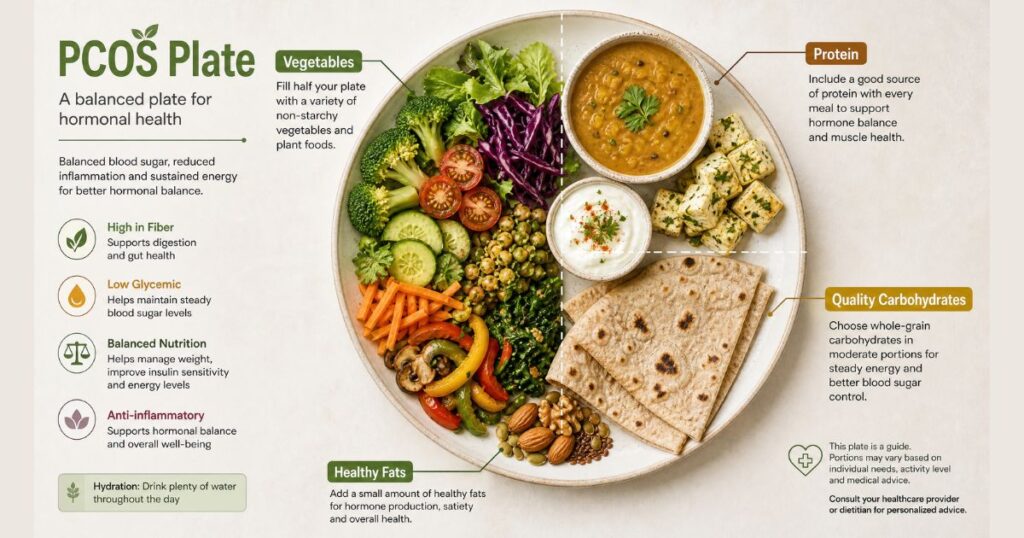
- Half the plate — vegetables. Sabzi, salad, saag, bhindi, lauki, beans, gourds, palak. Volume, fibre and micronutrients with little impact on blood sugar.
- A quarter — protein. Dal, rajma, chana, paneer, curd/dahi, tofu, soya, eggs, fish or chicken. Protein steadies blood sugar and keeps you full.
- A quarter — slow carbohydrate. Millet roti, whole-wheat roti, a modest portion of rice (ideally brown, red or hand-pounded), or whole grains. Not banished — just right-sized and slower.
- A little healthy fat. A drizzle of ghee, mustard/groundnut oil, a few nuts or seeds, or curd. Fat further slows digestion and adds satiety.
The single most useful habit is simply this: never eat a carbohydrate alone. Roti with dal and sabzi behaves very differently in your body than roti with pickle, or rice by itself. Pairing is more powerful than restriction.
Carbohydrate quality: rice, roti, millets & the truth about “carbs”
Carbohydrates are not the enemy — the quality and portion are what matter. The glycaemic index (GI) ranks how quickly a food raises blood sugar: roughly, 55 or below is low, 56–69 is medium, and 70 or above is high. Indian testing gives helpful patterns, though cooking style and what you pair a food with can shift these numbers.
| Everyday staple | Tends to be | Practical takeaway |
|---|---|---|
| Maida, white bread, sugary drinks | High GI | Limit; keep for occasional treats, not daily. |
| White rice | Higher GI | Enjoy in modest portions; pair with dal, veg and curd; try brown/red/hand-pounded rice. |
| Whole-wheat roti | Medium GI | A solid everyday base; pairs well with protein and sabzi. |
| Millets (ragi, jowar, bajra, foxtail, barnyard) | Lower GI, high fibre | Rotate in 3–4 times a week as roti, dosa, khichdi or porridge. |
| Dals and legumes | Low GI, high protein | Anchor most meals here — steady energy and protein together. |
| Oats, brown rice, quinoa | Low–medium GI | Useful breakfast and bowl bases. |
The pattern to remember from Indian nutrition research: dal-based dishes tend to keep blood sugar steady, while refined rice- and maida-based dishes spike it. You do not have to give up rice or dosa — shift the base grain where you can (a millet dosa batter, a half portion of rice), and always partner it with protein and vegetables. Millets are a genuinely good fit for Indian kitchens because they are lower-GI, high in fibre, and already part of our food culture — but they are an upgrade, not a miracle.
Protein and fibre — the two anchors
If you remember only two words, make them protein and fibre. Together they slow digestion, blunt sugar spikes, support satiety and help preserve muscle. Many Indian meals are carb-heavy and protein-light, so consciously adding protein to each meal is often the highest-impact change.
Vegetarian protein options
Dal, rajma, chana, lobia, moong, masoor; paneer and curd/dahi; tofu and soya chunks; sprouts; besan (chilla, cheela); milk; nuts and seeds (peanuts, almonds, til, pumpkin and sunflower seeds). Combining a cereal with a pulse (roti + dal, rice + rajma, idli + sambar) improves protein quality — something Indian cuisine already does beautifully.
Non-vegetarian protein options
Eggs, fish (including oily fish like rohu or mackerel for omega-3s), chicken, and lean meats. Grilled, curried, steamed or roasted all work — the cooking method matters less than the portion and what surrounds it on the plate.
Fibre
Vegetables, whole fruits, whole grains, millets, legumes, and the skins of pulses and produce all add fibre. Aim to make vegetables the largest part of most meals — they are the easiest win in an Indian kitchen.
Healthy fats, fruit and hydration
Fats are not off-limits. Include moderate amounts of ghee, cold-pressed oils (mustard, groundnut, sesame), nuts, seeds and, if you eat fish, its natural omega-3s. These support hormone health and help you feel satisfied, which reduces cravings.
Fruit is fine — you do not need to fear it. Whole fruit comes packaged with fibre that slows its sugar, so an apple, guava, papaya, orange, berries or a modest portion of banana is very different from fruit juice, which removes the fibre and concentrates the sugar. Prefer whole fruit over juice, and pair fruit with a few nuts or curd if you like.
Hydration and habits matter too: water through the day, and being mindful of how often sweetened chai, coffee, soft drinks and packaged juices add up. Small daily choices outweigh occasional treats.
Foods to enjoy freely vs foods to limit
Think “mostly” and “occasionally,” not “allowed” and “banned.” Nothing here is forbidden; it is about proportion and frequency.
| Enjoy most days | Keep occasional |
|---|---|
| Vegetables of all kinds; leafy greens | Maida foods: white bread, naan, biscuits, samosa, kachori |
| Dals, legumes, sprouts, rajma, chana | Sugary drinks, packaged juices, sweetened chai |
| Millets, whole-wheat roti, brown/red rice (portioned) | Mithai and desserts — for festivals and treats, not daily |
| Paneer, curd, eggs, fish, chicken, tofu, soya | Deep-fried snacks; heavily processed/packaged foods |
| Nuts, seeds, ghee and cold-pressed oils (in moderation) | Refined-carb cereals and “instant” breakfast mixes |
| Whole fruit; water; buttermilk/chaas | Fruit juice; energy/sports drinks |
A flexible day on the plate (examples, not a prescription)
This is an illustration of the pattern in action — mix, match and adapt to your region, taste and appetite. It is not a personalised plan, and portion sizes should suit you.
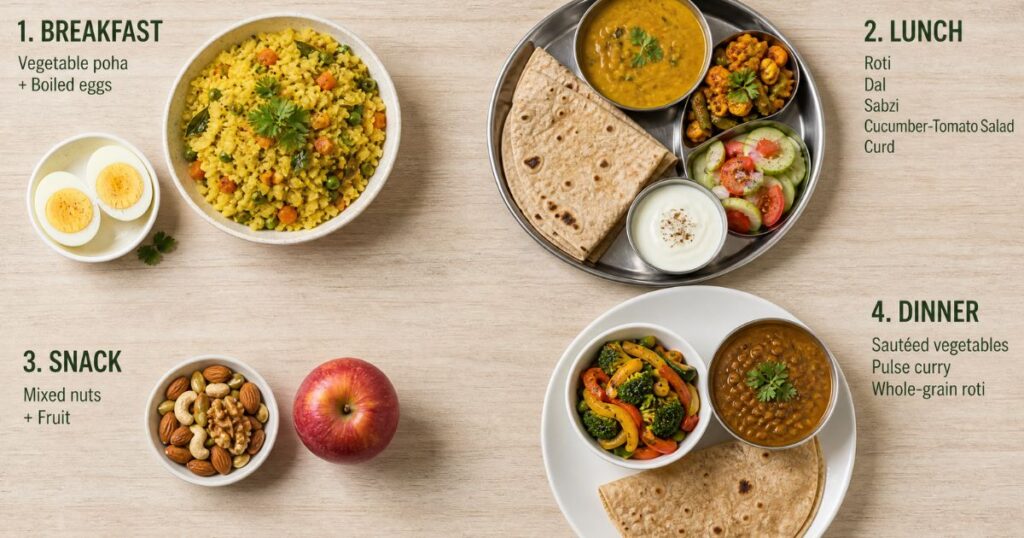
Vegetarian day
- Breakfast: Vegetable besan chilla with curd; or moong dal dosa; or oats upma with peanuts. Add a boiled egg if you eat them.
- Lunch: Two millet or whole-wheat rotis + dal + a big vegetable sabzi + salad + a bowl of curd.
- Snack: A handful of roasted chana or nuts; or sprouts chaat; or fruit with a few almonds.
- Dinner: Rajma or chole + a small portion of brown rice or roti + sauteed greens.
Non-vegetarian day
- Breakfast: Vegetable omelette (2 eggs) with a millet roti; or egg bhurji with sauteed veg.
- Lunch: Grilled or curried fish/chicken + salad + a millet roti or modest rice + a vegetable.
- Snack: Chaas/buttermilk; or a boiled egg; or fruit with nuts.
- Dinner: Chicken and vegetable stew or curry + roti + salad; keep dinner lighter and earlier where you can.
Notice the common thread: every meal has vegetables, a clear protein, a slow carbohydrate and some fat. That structure — repeated flexibly — is the whole strategy.
Eating out, festivals and real life
A sustainable PCOS way of eating has room for life. A few gentle habits help:
- Eat a little protein or a few nuts before a party so you are not ravenous; you will naturally choose better.
- At restaurants, anchor the meal with a protein (dal, paneer, fish, chicken, tandoori items) and vegetables, and treat rice/naan as the side, not the centre.
- During festivals, enjoy the mithai — mindfully. One plate savoured beats a week of guilt. Balance the day around it with lighter, protein-and-veg meals.
- Alcohol and sweets are best occasional; sweetened drinks are the easiest thing to reduce for a quick win.
Guilt and shame are not ingredients. A consistent everyday pattern with the occasional celebration is far more effective — and far more livable — than a rigid diet you abandon in a fortnight.
Sugar, dairy, gluten, soy, tea & coffee — myths and nuance
Sugar & refined carbs. This is where restraint genuinely helps. Sugary drinks, mithai and maida foods cause the sharpest blood-sugar swings, so making these occasional is one of the most worthwhile changes.
Dairy. You do not need to cut dairy to manage PCOS — the evidence does not support blanket elimination. Curd and other fermented dairy may even be helpful for gut health. If you have PCOS-related acne, some people find trimming low-fat/skimmed milk worth a short trial, but keep dairy unless you have a clear reason (like lactose intolerance) to stop, and replace its calcium and protein if you do.
Gluten. Unless you have coeliac disease or diagnosed gluten sensitivity, there is no strong evidence that going gluten-free improves PCOS. Whole-wheat roti and other whole grains provide valuable fibre and nutrients. If someone feels better off gluten, it is often because they cut refined maida foods — not the gluten itself. Cutting gluten carelessly can lower fibre, iron and folate.
Soy. Soy (tofu, soya chunks, soya milk) is generally fine and a useful protein, especially for vegetarians; there is no good reason for most women with PCOS to avoid it.
Tea & coffee. Moderate tea or coffee is fine for most people. What matters more is what goes in — lots of sugar, or several sweetened cups a day, add up quietly. Consider less sugar rather than giving up the cup.
The overarching truth: single-food elimination is rarely the answer. Overall diet quality, portion and consistency matter far more than banishing any one food group.
Beyond the plate: movement, sleep and stress
Diet works best alongside the rest of daily life. Guidelines recommend a healthy lifestyle for all women with PCOS, with benefits even in the absence of weight loss. Regular movement you enjoy — brisk walking, strength work, dance, yoga — improves insulin sensitivity. Adequate, regular sleep and managing stress matter too, because both affect the same hormonal and metabolic pathways as food. Where weight management is appropriate, guidelines note that even a modest change can help cycle regularity for some women — but the aim is health and how you feel, not a number on the scale, and PCOS care should never come wrapped in shame.
Where supplements fit
Supplements can play a supportive role for some people, but they do not replace a good diet, a healthy lifestyle, or medical care. Some couples planning a pregnancy use doctor-guided preconception nutrition; Surishi’s ASTA-CoQ10 is one such non-hormonal fertility-nutrition supplement, intended to be used as directed by a healthcare professional. Popular options such as myo-inositol have promising but not yet definitive evidence in PCOS, and are best discussed with your doctor. Think of any supplement as a possible add-on to good food and care — never a substitute for them.
When to seek medical care
Food is powerful, but it is one part of PCOS care. Please speak to a qualified doctor or a registered dietitian if you:
- have very irregular or absent periods, or are trying to conceive without success;
- have symptoms such as rapid weight change, severe acne, marked hair growth or hair loss;
- have signs of high blood sugar, or a family history of diabetes;
- feel overwhelmed, low, or anxious about food, weight or your body — support is available and important;
- want a plan tailored to your health, medicines, and preferences — a registered dietitian can personalise safely.
A professional can confirm what is going on, check for related conditions, and tailor nutrition to you — especially if you have other health issues or take medication.
A good PCOS diet for Indian women is not a punishing list of forbidden foods — it is a warm, familiar, flexible pattern: vegetables and protein at the centre, slower carbohydrates in sensible portions, healthy fats, whole fruit, and refined sugar kept occasional. No single food will make or break you, and no single “miracle” diet is proven best. Consistency, balance and kindness to yourself will take you further than any crash plan — and if you need help, a doctor or dietitian can personalise the details.
FAQs :
Q1. What is the best diet for PCOS for Indian women?
There is no single “best” PCOS diet. A balanced Indian pattern works well: vegetables and protein (dal, curd, paneer, eggs, fish, chicken) at the centre, slower carbohydrates like millets and whole-wheat roti in sensible portions, healthy fats, whole fruit, and refined sugar kept occasional. Consistency matters more than perfection.
Q2. Can I eat rice if I have PCOS?
Yes, in modest portions and paired with protein and vegetables. Choosing brown, red or hand-pounded rice, or swapping in millets a few times a week, gives a slower blood-sugar rise than white rice or maida foods.
Q3. Are millets good for PCOS?
Millets like ragi, jowar, bajra and foxtail are generally lower on the glycaemic index and high in fibre, which suits Indian meals well. They are a helpful upgrade from refined grains, though not a cure — the whole eating pattern is what counts.
Q4. Should I cut dairy and gluten for PCOS?
Usually not. Evidence does not support blanket elimination of dairy or gluten unless you have a specific condition such as lactose intolerance, coeliac disease or gluten sensitivity. Overall diet quality matters more than removing single foods; cutting them carelessly can reduce important nutrients.
Q5. Is fruit bad for PCOS?
No. Whole fruit comes with fibre that slows its sugar, so options like guava, apple, papaya, orange, berries and a modest banana are fine. Prefer whole fruit over juice, which removes the fibre and concentrates the sugar.
Q6. What foods should I limit with PCOS?
Keep refined and sugary foods occasional: maida items (white bread, biscuits, samosa), sugary drinks and packaged juices, mithai and deep-fried snacks. These cause the sharpest blood-sugar swings.
Q7. Do I need to lose weight to manage PCOS through diet?
Not necessarily. A healthy eating pattern helps regardless of weight, and guidelines note benefits even without weight loss. Where weight management is appropriate, even a modest change can help some women — but the focus should be health, not a number, and never shame.
Q8. Can a PCOS diet cure PCOS or guarantee pregnancy?
No. Diet and lifestyle can meaningfully improve symptoms and metabolic health, but they do not cure PCOS or guarantee conception. They work best alongside medical care tailored to you.