
If you are trying to conceive — especially after 35 — you have probably come across CoQ10 for fertility as a supplement said to “improve egg quality.” Here is the honest, research-based summary first. CoQ10 (coenzyme Q10) is a natural compound your body uses to make cellular energy and to protect cells from oxidative stress. Eggs are especially energy-hungry, and egg quality declines with age partly because the mitochondria inside them work less efficiently. That is the logical basis for interest in CoQ10.
What does the human evidence show? The most consistent signals come from women with diminished ovarian reserve (DOR) or a poor response to IVF: several trials suggest CoQ10 taken before an IVF cycle may improve intermediate markers such as the number of eggs retrieved, fertilisation rate and embryo quality. But — and this matters — there is no reliable proof yet that CoQ10 increases pregnancy or live-birth rates. Below we explain the science, who might reasonably discuss it with a fertility specialist, and the practical caveats around dose, timing, safety and realistic expectations.
What is CoQ10?
Coenzyme Q10 (also called ubiquinone) is a vitamin-like substance found in nearly every cell of the body. It has two main jobs. First, it is an essential part of the “electron transport chain” inside mitochondria — the tiny power plants that turn nutrients into ATP, the energy currency your cells run on. Second, it acts as an antioxidant, helping neutralise reactive oxygen species (ROS) — unstable molecules that can damage cells when they build up. Your body makes CoQ10 and you also get small amounts from food, but natural production tends to decline with age.
You may see two forms on labels: ubiquinone (the oxidised form) and ubiquinol (the reduced, “ready to use” form). Both are used in studies. Because CoQ10 is fat-soluble, it is generally absorbed better when taken with a meal containing some fat.
Mitochondria, oxidative stress and egg quality
An egg (oocyte) is one of the most energy-demanding cells in the body. Maturing correctly, lining up chromosomes and supporting early embryo development all require a great deal of ATP — and that ATP comes mainly from mitochondria. As a woman ages, the mitochondria in her eggs tend to become less efficient, producing less energy and more oxidative stress. This is one reason egg quality and the chance of a healthy embryo decline with age.
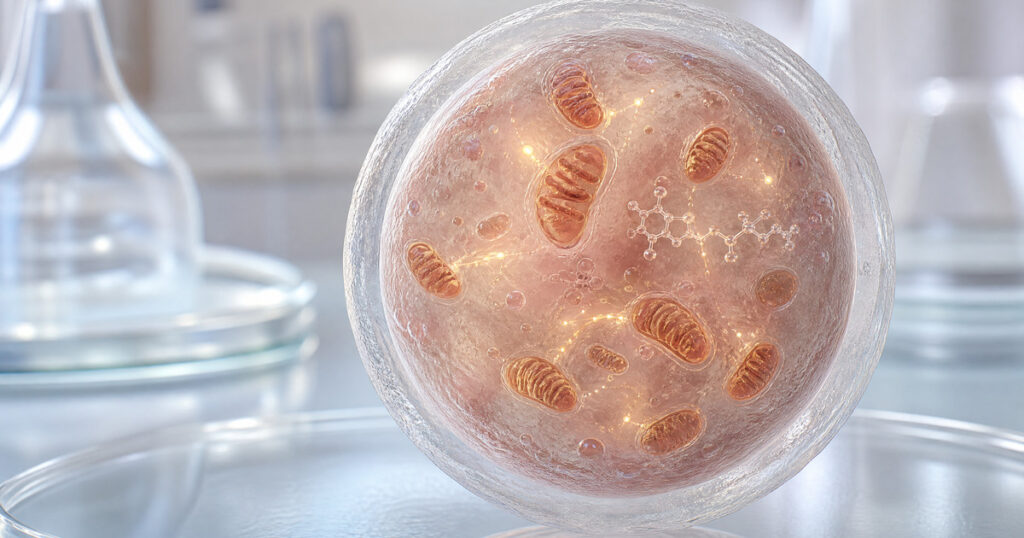
A landmark laboratory study in mice and human tissue found that ageing eggs show mitochondrial dysfunction and reduced ATP, alongside falling levels of the enzymes needed to make CoQ10 — and that giving CoQ10 could reverse some of these age-related changes in mice. This is an important clue about mechanism, but animal findings do not automatically translate to human pregnancies. It explains why researchers became interested in CoQ10 — not proof that it works for people.
| Why this matters for expectations The mitochondrial theory is genuinely compelling, and it is why CoQ10 is one of the most studied fertility supplements. But a strong biological rationale is a reason to test something, not evidence that it delivers babies. Keep the mechanism and the human results separate in your mind — the sections below focus on what human trials actually measured. |
What the research says about CoQ10 for fertility
The clearest human data is in women with diminished ovarian reserve (fewer eggs than expected for age) or a poor response to ovarian stimulation, taking CoQ10 as a pre-treatment before IVF. A 2024 systematic review and meta-analysis pooled six randomised controlled trials involving over 1,500 such women. It reported that CoQ10 pre-treatment was associated with more eggs retrieved, a higher fertilisation rate and more good-quality embryos compared with no pre-treatment.
A representative randomised trial in younger women with poor ovarian reserve found similar benefits — more oocytes, higher fertilisation, more high-quality embryos and fewer cancelled cycles after about 60 days of CoQ10 before IVF. Crucially, though, clinical pregnancy and live-birth rates only trended higher and did not reach statistical significance. In plain terms: CoQ10 may improve the “raw material” (eggs and embryos), but we do not yet have solid proof that this reliably translates into more babies.
Broader reviews of antioxidants in ovarian ageing point the same way: a possible benefit for women with reduced ovarian reserve, apparently more noticeable in younger women, but with live-birth evidence still limited. For women with normal ovarian reserve, or those simply hoping to “boost” fertility without a specific problem, the evidence is much thinner.
What about male fertility?
Fertility is a two-person equation, and CoQ10 has been studied in men too. Meta-analyses of men with unexplained (idiopathic) infertility suggest CoQ10 may improve semen parameters — sperm concentration, motility and morphology — likely through the same antioxidant and mitochondrial-energy effects (sperm also rely heavily on mitochondria to swim). As with eggs, however, improvements in lab measures have not consistently translated into higher pregnancy or live-birth rates, and studies are variable in quality. If male-factor infertility is a concern, semen analysis and a specialist’s advice come first.
Who might reasonably consider CoQ10 — and who should decide
Based on where the evidence is strongest, the people most often discussed in the research are:
- Women with diminished ovarian reserve or advanced maternal age preparing for IVF, as an adjunct to standard care.
- Women who have had a poor response (few eggs) in a previous stimulation cycle.
- Men with abnormal semen parameters and no other identified cause, as part of a wider plan.
Even for these groups, CoQ10 is best seen as a possible supportive adjunct — not a substitute for medical evaluation or fertility treatment, and not a guarantee. The single most useful step is a proper assessment by a gynaecologist or fertility specialist, who can look at your ovarian reserve, cycle, partner’s semen analysis and overall health, and advise whether CoQ10 fits your specific situation.
Dose, timing and how long it takes
For context only — and not as a personal recommendation — fertility studies in women have typically used roughly 200–600 mg of CoQ10 per day, and studies in men around 100–300 mg per day, usually for at least three months. The three-month window reflects biology: it takes roughly that long for a batch of eggs to mature to the point of ovulation, and a similar span for a cycle of sperm production, so any effect needs time to appear. CoQ10 is fat-soluble, so it is usually taken with food.
These are research figures, not a prescription. Supplement quality, form (ubiquinone vs ubiquinol) and dose vary widely between brands, and supplements are not regulated as strictly as medicines. The sensible approach is to decide with a qualified doctor what — if anything — is appropriate for you, rather than self-prescribing from an article or an advertisement.
Is CoQ10 safe? Side effects and interactions
CoQ10 has a reassuring safety record and is generally well tolerated, even at the higher doses used in fertility research. When side effects occur they are usually mild — for example, stomach upset, nausea, headache, or trouble sleeping — and often ease if the dose is split or taken with food. Serious toxicity is not typically reported.
A few important cautions, which is why medical input matters:
- CoQ10 may interact with blood thinners such as warfarin, potentially affecting how well they work.
- It may have a mild effect on blood pressure, which can matter if you take antihypertensive medicines.
- If you take other regular medicines, have a chronic condition, or are already pregnant, check with your doctor before starting any supplement.
Where CoQ10 fits — and the ASTA-CoQ range
The foundations of fertility are not found in any single supplement: a balanced diet, healthy weight, not smoking, limiting alcohol, managing conditions like diabetes or thyroid disorders, and — importantly — not delaying a specialist assessment when needed. Antioxidant supplements such as CoQ10 sit alongside this foundation as a possible adjunct for some people, never as a replacement for medical care.
Within Surishi’s range, ASTA-CoQ is a combination antioxidant supplement that includes coenzyme Q10 together with astaxanthin (a potent antioxidant) and other supportive nutrients. It is offered as general antioxidant and reproductive-wellness support — not as a treatment that improves egg quality or guarantees pregnancy, claims no responsible supplement should make. Whether a product like this is right for you depends on your individual situation, so please review the current product details and discuss suitability with your doctor before starting. You can see the up-to-date composition on the ASTA-CoQ product page, and explore Surishi’s wider women’s health range.
When to see a doctor
- You have been trying to conceive for 12 months without success — or 6 months if you are over 35, or sooner if you already know of a fertility issue.
- You have very irregular or absent periods, known ovarian or hormonal conditions, or a history of pelvic surgery or infection.
- You or your partner have a known reason for reduced fertility (for example, low ovarian reserve or an abnormal semen analysis).
- You are taking other medicines, have a chronic condition, or are already pregnant and want to add any supplement.
- The emotional strain of trying to conceive is affecting your wellbeing — support is part of fertility care and worth asking for.
| Medical disclaimer This article is for general education only and is not a substitute for professional medical advice, diagnosis or treatment. It does not diagnose any condition, promise any fertility or pregnancy outcome, or recommend a personal treatment plan. Do not start, stop or change any prescription medicine or fertility treatment based on this content. Always consult a qualified doctor, gynaecologist or fertility specialist about your individual situation — especially if you are pregnant, planning pregnancy, or taking other medicines. |
FAQs :
Q1. Does CoQ10 really improve egg quality?
CoQ10 supports the mitochondria that power eggs, and studies in women with diminished ovarian reserve suggest it may improve markers like the number of eggs retrieved and embryo quality before IVF. However, it has not been proven to reliably increase pregnancy or live-birth rates, so it is best viewed as a possible adjunct discussed with a fertility specialist.
Q2. Can CoQ10 help me get pregnant?
There is no reliable proof that CoQ10 on its own increases the chance of pregnancy or a live birth. The clearest signals are for improved egg and embryo markers in women with poor ovarian reserve undergoing IVF. If you are trying to conceive, a proper assessment by a gynaecologist or fertility specialist is the evidence-based first step.
Q3. How much CoQ10 is used in fertility studies?
Studies in women have generally used about 200–600 mg a day, and in men about 100–300 mg a day, usually for at least three months. These are research figures, not a personal recommendation — the right choice for you should be decided with a qualified doctor.
Q4. How long does CoQ10 take to work for fertility?
Most studies run for at least three months, because that is roughly how long it takes eggs to mature toward ovulation and for a cycle of sperm production. Any effect, if it occurs, needs time to appear — quick results should not be expected.
Q5. Is CoQ10 safe? Are there side effects or interactions?
CoQ10 is generally well tolerated. Side effects are usually mild, such as stomach upset, headache or sleep changes. It may interact with blood thinners like warfarin and with blood-pressure medicines, so check with your doctor before starting, especially if you take other medications or are pregnant.
Q6. Ubiquinol or ubiquinone — which form is better?
Both forms are used in research. Ubiquinol is the “ready to use” form and may be absorbed a little more easily by some people, but there is no conclusive proof that one form produces better fertility outcomes. Taking either with a fatty meal helps absorption.
Q7. Does CoQ10 help male fertility too?
Possibly. Reviews in men with unexplained infertility suggest CoQ10 may improve sperm concentration, motility and shape, though better lab measures have not consistently led to higher pregnancy rates. Semen analysis and a specialist’s guidance should come first.