
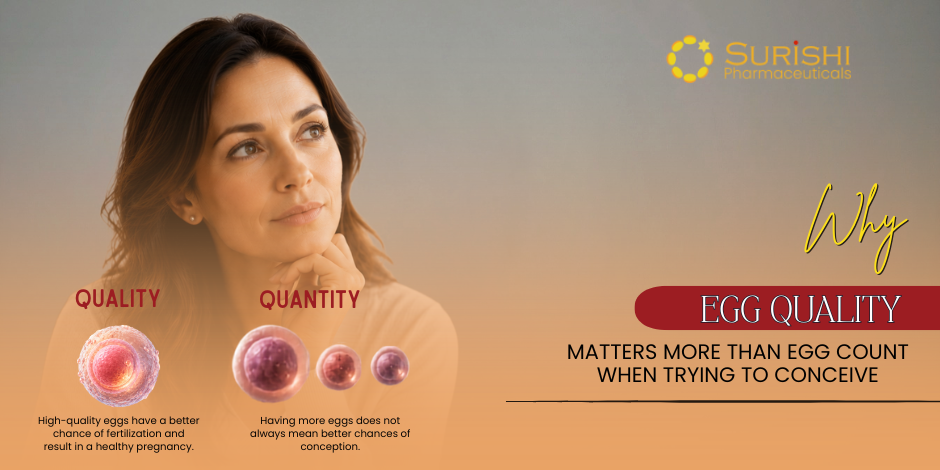
When women start their fertility journey, the first question most ask is, ‘How many eggs do I have left?” It is a fair question. But fertility specialists will tell you that the number of eggs is only part of the picture, and sometimes not even the most important part.
The quality of your eggs plays a far bigger role in whether a pregnancy happens, whether it continues, and whether a healthy baby is born. Yet most women hear about egg quality only after something has already gone wrong, such as a failed IVF cycle, a miscarriage, or months of unexplained difficulty conceiving.
This blog breaks down what egg quality actually means, what affects it, and what women can do about it.
What Does Egg Quality Actually Mean?
Every egg a woman releases during ovulation carries genetic material, chromosomes that will combine with sperm to form an embryo. A good-quality egg has the right number of chromosomes, healthy DNA, and sufficient cellular energy to fertilise properly and develop into a healthy embryo.
A poor-quality egg may have chromosomal errors, damaged DNA, or insufficient energy at the cellular level. This leads to fertilisation failure, poor embryo development, failed implantation, or early miscarriage, even when sperm quality is perfectly normal.
This scenario is why two women with the same egg count can have very different pregnancy outcomes. One may conceive easily. The other may struggle despite having similar numbers on paper.
What Affects Egg Quality?
Age is the single biggest factor. Women are born with all the eggs they will ever have. As those eggs age inside the body, their cellular machinery, particularly the mitochondria, the energy-producing units inside each cell, gradually loses efficiency. By the mid-30s, this decline becomes noticeable. By 40, it is significant.
Mitochondrial health is directly linked to egg quality. Each mature egg contains hundreds of thousands of mitochondria. These tiny structures produce the energy the egg needs to complete the final stages of maturation, fertilise successfully, and support the early division of the embryo.
Mitochondrial dysfunction causes an insufficient energy supply in oocytes, leaving the cells unable to complete their developmental steps and triggering chromosomal errors, oocyte fragmentation, and developmental failure.
This is why mitochondrial support has become a core research priority in modern reproductive medicine. Doctors now recommend supplements specifically formulated to optimise mitochondrial function, such as MITOV, India’s first mitochondrial optimiser developed for female fertility, as part of pre-conception and pre-IVF preparation protocols.
Hormonal imbalances, such as those seen in PCOS, affect the environment in which eggs mature. Poor follicular status can lead to underdevelopment and low-quality pre-ovulatory oocytes.
Four common triggering factors, including malnutrition and chronic stress, can induce oxidative stress, which damages the DNA and cellular structure of oocytes. Women aged 35 and above require antioxidant protection to maintain oocyte quality.
Low AMH (Anti-Mullerian Hormone) is often associated with reduced ovarian reserve, which frequently correlates with declining egg quality alongside reduced quantity.
Why Egg Count Can Be Misleading
A woman with 15 eggs retrieved during IVF may end up with fewer viable embryos than a woman who retrieved only 6 if the quality of the first woman’s eggs is poor. Clinics that focus only on stimulating large numbers of eggs, without addressing quality, often see disappointing fertilisation and blastocyst rates.
This information is particularly relevant for women who are poor responders. This includes women who produce fewer follicles despite high stimulation and those with a low ovarian reserve. In these cases, the conversation must shift entirely to quality optimization rather than quantity chasing.
How Long Does It Take to Improve Egg Quality?
Eggs take approximately 90 days to mature before ovulation. This is why fertility specialists recommend starting preconception preparation at least 3 months before trying to conceive, or before beginning an IVF or IUI cycle.
During this window, targeted nutritional support, mitochondrial optimization, and antioxidant supplementation can meaningfully improve the cellular environment in which eggs are maturing. This is the reasoning behind a structured supplementation protocol that starts with higher support in the first month and maintains it throughout the preparation period.
What Can Women Do to Support Egg Quality?
1. Prioritise antioxidant-rich nutrition. Colourful vegetables, berries, nuts, and seeds can help reduce oxidative damage to your eggs.
2. Manage chronic stress, which elevates cortisol and disrupts the hormonal environment needed for healthy follicle development.
3. Avoid smoking and limit alcohol, both of which are directly toxic to egg quality
636
4. Support mitochondrial function through targeted supplementation. CoQ10, NMN, and antioxidants like astaxanthin have clinical evidence supporting their role in oocyte health.
5. Begin preparation early, ideally 3 months before any fertility treatment or conception attempt.
The Bottom Line
If you have been told your egg count is low, or if you have faced failed IVF cycles or early miscarriages, the conversation about egg quality is one worth having with your doctor. The encouraging news is that the window between now and your next cycle, roughly 90 days, is a genuine opportunity to improve the cellular health of your eggs.
Egg quality is not entirely beyond your control. With the right support, timing, and preparation, many women significantly improve their fertility outcomes.
Frequently Asked Questions
1. Does egg quality matter more than egg count for IVF success?
Yes, in most cases. In the IVF field, clinical consensus holds that a small number of high-quality eggs produce far better outcomes than a large number of low-quality eggs. High-quality eggs support normal fertilisation and embryonic development, ultimately leading to a healthy pregnancy.
2. What is the role of mitochondria in egg quality?
Mitochondria are the energy-producing structures inside cells. The mitochondrial content of egg cells is far higher than that of any other cell in the body, as these organelles must supply energy to support the egg’s own maturation, fertilisation, and early embryonic development. A decline in mitochondrial function is one of the core reasons that advancing age leads to reduced egg quality.
3. How does MITOV support egg quality?
MITOV, India’s first mitochondrial optimiser specifically developed for female fertility, contains the core active ingredients NMN, CoQ10, and astaxanthin. This can supply energy to the mitochondria of mature oocytes, reduce oxidative damage, and optimize the overall developmental environment.
4. At what age does egg quality start declining?
A woman’s egg quality declines in stages as she ages, and the rate of this decline accelerates significantly after age 35. However, age is by no means the only factor affecting egg quality; other variables also influence this physiological process.
(Message in Public Interest by Surishi Academic Council | Makers of MITOV)