

Most women think about calcium only when a doctor mentions it — usually after a fracture, a difficult pregnancy, or a blood test flagging low vitamin D. By then, the groundwork laid down in the teens and twenties has often already set the ceiling for how strong the skeleton will be for the rest of life. Calcium and vitamin D are not an “older woman’s” concern. They matter at every stage, and they matter more for women than for men, because a woman’s bones face demands — pregnancy, breastfeeding, and the sharp drop in oestrogen at menopause — that men’s never do.
What makes this a particularly Indian story is that the two nutrients fall short here in ways they often don’t elsewhere. Most Indian adults take in only about 300–500 mg of calcium a day, well under the roughly 1,000 mg recommended — and vitamin D levels are low across much of the population despite abundant sunshine. Understanding how these two nutrients work, how much you actually need, and where to get them is one of the more useful things a woman can do for her long-term health.
Key Takeaways
- Calcium builds and maintains bone; vitamin D is what lets your body absorb that calcium in the first place. One without the other does little good.
- The Indian Council of Medical Research (ICMR-NIN, 2020) recommends about 1,000 mg of calcium and 600 IU (15 mcg) of vitamin D a day for most adults — yet typical Indian intake of calcium is only a third to a half of that.
- Needs rise at specific stages : adolescence, pregnancy, breastfeeding, and especially after menopause.
- Most vague symptoms — tiredness, aches, cramps — are not a reliable sign of deficiency. A blood test, not a symptom checklist, is how deficiency is confirmed.
- Food should come first. Supplements are for people who genuinely can’t meet their needs through diet or who have been found deficient.
Why Calcium and Vitamin D Matter for Women
Nearly all the calcium in your body — about 98–99% — is stored in your bones and teeth, where it acts as both structural material and a reserve the body draws on to keep blood calcium steady. That small amount circulating in the blood runs essential, moment-to-moment jobs: muscle contraction, nerve signalling, blood clotting and hormone release. When dietary calcium runs short, the body quietly withdraws it from the skeleton to keep those functions going. Do that for years and bones gradually thin.
A woman’s skeleton is on a particular timeline. Bone mass builds through childhood and adolescence, peaks in the late twenties to early thirties, and then slowly declines. The decline turns steep at menopause: as oestrogen falls, the rate of bone breakdown overtakes bone building, and women lose roughly 1% of their bone mineral density per year in the years around and after menopause. This is why osteoporosis — fragile bones that fracture easily — is far more common in women than in men, and why fractures of the hip, spine and wrist become a real risk in later life. It is a similar story to iron, another nutrient many Indian women fall short of: the shortfall is quiet until it isn’t.
Vitamin D’s role is quieter but just as important. Without enough of it, the intestines can only absorb a fraction of the calcium you eat. Severe, long-standing vitamin D deficiency causes rickets in children and osteomalacia (softening of the bones) in adults. More commonly, a modest shortfall simply makes it harder to hold onto bone, compounding the calcium problem.
How Calcium and Vitamin D Work Together
It helps to think of them as a supply chain rather than two separate nutrients. Calcium is the raw material; vitamin D is the key that unlocks the gut so that calcium can actually enter the bloodstream. Vitamin D is converted in the body to its active form, which signals the intestine to absorb calcium efficiently and helps keep blood calcium and phosphate at the levels bone needs to mineralise properly.
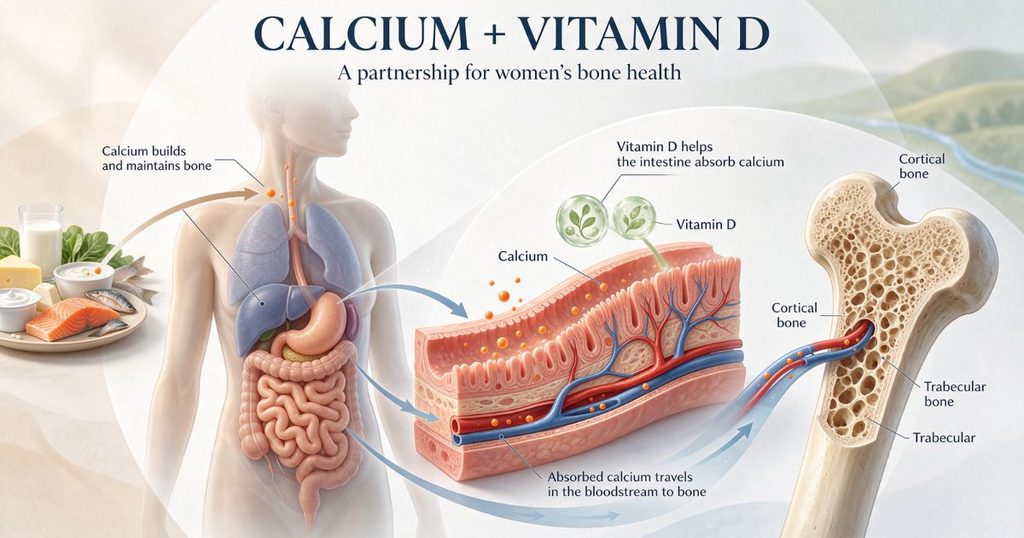
When vitamin D is low, the body compensates by pulling more calcium out of bone to keep blood levels normal — so a vitamin D problem can quietly become a bone problem even when calcium intake looks adequate. This interdependence is why health authorities almost always discuss the two together, and why taking a large calcium supplement while remaining deficient in vitamin D is an inefficient fix.
How Much Calcium and Vitamin D Do Women Need?
This is where guidance differs by country, and it’s worth being clear about why. India has its own reference values, set by ICMR-NIN, which are based on Indian body sizes, diets and absorption patterns. US figures (from the Institute of Medicine, used by the NIH) are higher for some groups. Neither is “wrong” — they’re built for different populations.
| Nutrient (adult women) | ICMR-NIN 2020 (India) | US / IOM (NIH) |
|---|---|---|
| Calcium | ~1,000 mg/day | 1,000 mg (19–50 yrs); 1,200 mg (51+ yrs) |
| Vitamin D | 600 IU (15 mcg)/day | 600 IU (15 mcg); 800 IU (20 mcg) after 70 |
The headline point is not the small gap between the two systems — it’s the enormous gap between any recommendation and what Indian women typically eat. When average calcium intake sits around 300–500 mg against a target near 1,000 mg, the practical task for most women isn’t fine-tuning between 1,000 and 1,200; it’s closing a shortfall of several hundred milligrams a day.
Calcium and Vitamin D Needs by Age and Life Stage
Requirements aren’t fixed across life. Using the Indian (ICMR-NIN 2020) framework as the reference point :
- Adolescent girls (roughly 10–18) : This is the single most important window. Bone is being laid down fast, calcium needs are at their lifetime peak, and what’s banked now determines how much there is to lose later.
- Adult women (19 to menopause) : Around 1,000 mg calcium and 600 IU vitamin D a day to maintain the skeleton and support everyday calcium functions.
- Pregnancy and breastfeeding : Needs are elevated to support the baby’s developing skeleton without stripping the mother’s — more on this below.
- After menopause : The period of fastest bone loss. US guidance raises calcium to 1,200 mg for women over 50; Indian expert groups have debated the exact figure but agree the goal is to protect against accelerating loss.
Best Food Sources of Calcium
In Western countries, dairy supplies the majority of dietary calcium. In India the picture is different: a large share of calcium comes from non-dairy foods, and the typical diet is also high in phytates (compounds in whole grains, bran and some pulses) that bind calcium and reduce how much the body can absorb. That makes food choices — and variety — especially important here, and it’s one reason a diet that supports hormonal and nutritional health is built on more than one food group.
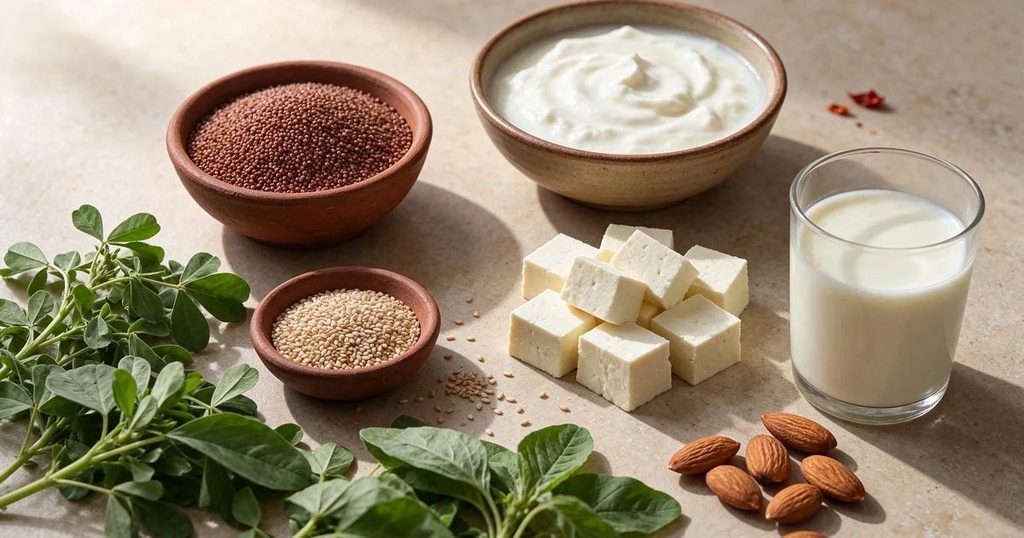
Reliable calcium-rich foods for Indian kitchens include :
- Milk, curd (dahi), paneer and cheese — a 200 ml glass of milk gives roughly 250 mg of calcium, so meeting the target through dairy alone would take around three servings a day.
- Ragi (finger millet) — one of India’s best plant sources, at about 344 mg per 100 g; sprouting it improves absorption.
- Sesame seeds (til), almonds and other nuts and seeds.
- Green leafy vegetables such as amaranth (chaulai), fenugreek (methi) and mustard greens. Note that spinach, though rich in calcium, is also very high in oxalate, so little of its calcium is actually absorbed.
- Pulses and beans, tofu set with calcium, and small fish eaten with the bones, such as sardines.
Because absorption from any single serving is limited, spreading calcium-rich foods across the day works better than trying to get it all at one meal.
Best Sources of Vitamin D
Vitamin D is harder to get from food than calcium, because very few foods contain much of it. The richest natural sources are fatty fish (salmon, mackerel, sardines) and cod liver oil; smaller amounts are found in egg yolk and, in some countries, fortified milk and cereals. For a largely vegetarian population, diet alone rarely covers vitamin D needs — which is why advanced Vitamin D3 formulations such as Femisun D exist for correcting a confirmed shortfall under medical advice.
That leaves sunlight, which is where the Indian paradox bites. The skin makes vitamin D when UVB rays strike it, and India has no shortage of sun — yet deficiency is widespread. The usual culprits are modern indoor lifestyles, covering the skin (for sun protection, custom or convenience), air pollution that filters UVB in cities, and naturally higher melanin, which slows vitamin D synthesis. Short, regular exposure of the arms and face to midday sun a few times a week helps, but it has to be balanced against skin-cancer risk, so it isn’t a complete answer for everyone. For many Indian women, a supplement — taken on advice — ends up being the practical route to adequacy.
Signs That May Be Linked With Deficiency
This is the part that needs honesty rather than a scary list. Mild or moderate calcium and vitamin D shortfalls often cause no clear symptoms at all — which is exactly why they go unnoticed. The everyday complaints people tend to blame on deficiency — tiredness, general body aches, muscle cramps, hair fall — are nonspecific. They have dozens of possible causes, and having them does not mean you are deficient.
Genuine, more advanced deficiency can show up as bone pain, muscle weakness, or fractures from minor knocks; in severe calcium deficiency, people may notice tingling around the mouth or in the hands and feet, or muscle spasms. But these point toward a medical evaluation, not self-diagnosis. The reliable way to know your vitamin D status is a blood test measuring 25-hydroxyvitamin D; calcium status is assessed by a doctor using the right combination of tests. A symptom checklist found online is not a substitute for either.
Who Is More at Risk of Calcium or Vitamin D Inadequacy?
Some women are more likely to fall short, and recognising yourself here is more useful than watching for symptoms:
- Women who eat little or no dairy, including many vegetarians and vegans
- Women with very limited sun exposure — those who stay mostly indoors, cover up outdoors, or live in heavily polluted cities
- Postmenopausal women, who both absorb calcium less efficiently and lose bone faster
- Pregnant and breastfeeding women, whose needs are higher
- Women with conditions that impair fat absorption (vitamin D is fat-soluble), such as coeliac or inflammatory bowel disease, and those who have had weight-loss surgery
- Older women generally, as the skin’s ability to make vitamin D declines with age
Calcium and Vitamin D During Pregnancy and Breastfeeding
Pregnancy places a real calcium demand on the mother as the baby’s skeleton forms, and adequate vitamin D supports that process; needs are higher during pregnancy across several nutrients, not just these two. Beyond bone, there is a well-established benefit in one specific situation: in women whose dietary calcium is low, calcium supplementation during pregnancy reduces the risk of pre-eclampsia, a dangerous rise in blood pressure. The World Health Organization and major obstetric bodies recommend calcium supplementation during pregnancy for women with low dietary intake — a group that includes many Indian women — and India’s own maternal health programmes provide calcium and vitamin D to pregnant women from the second trimester onwards.
The important caveat is that pregnancy is exactly the time not to self-prescribe. Doses and timing should come from the doctor or midwife managing the pregnancy, who can tailor them to the individual.
Calcium and Vitamin D After Menopause
Menopause is the hinge point for women’s bone health. As oestrogen falls, bone loss speeds up for several years, and the risk of osteoporosis and fractures climbs — part of the wider picture of women’s hormonal health. This is why calcium targets are often raised after 50 and why vitamin D adequacy becomes more important — the two together modestly slow bone loss and, in some studies, reduce fracture risk, though the evidence on supplements preventing fractures in otherwise healthy, well-nourished women is genuinely mixed.
What’s clear is that nutrition is only one lever. Weight-bearing and resistance exercise, not smoking, moderate alcohol, and a bone-density (DEXA) scan when a doctor advises it all matter alongside calcium and vitamin D. For women with established osteoporosis, these nutrients support treatment but don’t replace it.
Do Women Need Calcium and Vitamin D Supplements?
Not automatically. The clear direction from recent Indian expert guidance — including the Endocrine Society of India’s 2025 statement — is food first, supplements only when needed. Supplements are appropriate for women who cannot reach their requirements through diet, who have higher needs (such as pregnancy), or who have been tested and found deficient; our guide to women’s nutraceuticals explains how they fit into daily health. They are not a routine purchase for everyone.
A few safety points worth knowing. More is not better: the tolerable upper limits are around 2,000–2,500 mg a day for calcium and 4,000 IU a day for vitamin D in adults, and very high calcium from supplements has been linked in some studies to kidney stones. Calcium is absorbed best in doses of 500 mg or less taken with food. And for correcting ordinary vitamin D deficiency, Indian experts specifically recommend plain vitamin D3 rather than “activated” vitamin D (calcitriol), which is over-used in India and only needed for particular medical conditions. Calcium supplements can also interfere with certain medicines — including thyroid hormone (levothyroxine) and some antibiotics — so spacing matters.
When Should You Talk to a Doctor?
See a doctor rather than relying on this or any article if you have persistent bone pain, muscle weakness, a fracture from a minor fall, or symptoms like tingling or spasms. It’s also worth a conversation if you’re planning or going through pregnancy, are approaching or past menopause, follow a dairy-free diet, or simply want to know your vitamin D status — a simple blood test can settle it. A doctor can interpret the result in the context of your overall health and advise whether you need to change your diet, add a supplement, and at what dose. Those are decisions to make with a professional, not alone.
FAQs :
Q1 : How much calcium does a woman need each day?
For most adult women, about 1,000 mg a day (ICMR-NIN 2020). US guidance raises this to 1,200 mg for women over 50. Most women in India fall well short of either figure.
Q2 : How much vitamin D do women need?
ICMR-NIN recommends 600 IU (15 mcg) a day for adults. US guidance is the same up to 70, rising to 800 IU after that. These assume minimal sun exposure.
Q3 : Can women get enough calcium from food alone?
Many can, with planning — dairy, ragi, sesame, nuts, leafy greens and pulses all help. Because the typical Indian diet is both low in calcium and high in phytates, variety and consistency matter, and some women will still need a supplement on advice.
Q4 : What are the signs of calcium or vitamin D deficiency?
Often there are none in mild cases. Advanced deficiency can cause bone pain, muscle weakness or fractures, and severe calcium deficiency can cause tingling or spasms. Everyday tiredness and aches are not reliable signs — a blood test is how deficiency is confirmed.
Q5 : Does vitamin D really help calcium absorption?
Yes. Vitamin D is required for the gut to absorb calcium efficiently. Without enough vitamin D, much of the calcium you eat passes through unused, which is why the two are considered together.
Q6 : Should women take calcium and vitamin D supplements?
Only if they can’t meet their needs through food, have higher needs such as pregnancy, or have been found deficient. The current expert position is food first, supplements when genuinely needed — and ideally guided by a doctor.
Q7 : When should a woman get her vitamin D tested?
Testing isn’t recommended routinely for everyone, but it’s reasonable if you have risk factors (little sun exposure, a dairy-free diet, pregnancy, menopause) or symptoms your doctor thinks warrant it. The test measures 25-hydroxyvitamin D.
Medical Disclaimer
This article is for general educational purposes only and is not medical advice. It is not intended to diagnose, treat or replace consultation with a qualified healthcare professional. Nutrient needs, deficiency and supplement doses vary from person to person. Do not start, stop or change any supplement or medication based on this article. Please consult your doctor for advice specific to your health, especially if you are pregnant, breastfeeding, have a medical condition, or take other medicines.