
Few phrases are used as loosely in fertility conversations as “egg quality.” It gets blamed for almost every difficulty conceiving, offered as the reason one IVF cycle worked and another didn’t, and attached to supplements promising to restore it. Some of that reflects real biology. A lot of it blurs together several different things — how many eggs you have, how genetically normal they are, and what a blood test can actually measure — that deserve to be kept separate.
This guide takes egg quality apart carefully: what it means in reproductive medicine, how age affects it, what fertility tests can and cannot tell you, and where lifestyle and supplements genuinely fit. It avoids two opposite traps — the fatalism of the “biological clock” and the false hope that the right routine can turn back reproductive ageing. The truth sits in between, and it is more useful than either.
What “egg quality” actually means
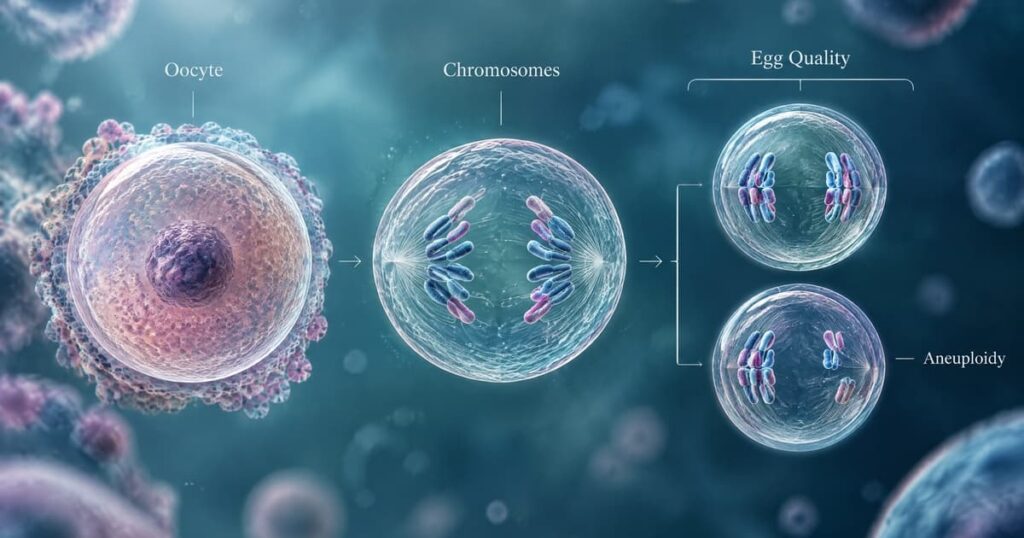
In reproductive medicine, egg (oocyte) quality refers mainly to an egg’s genetic and cellular competence — whether it carries the correct number of chromosomes and has the cellular machinery, including healthy mitochondria for energy, to be fertilised and develop into a healthy embryo. A “high-quality” egg is, above all, a chromosomally normal (euploid) one with the resources to support early development. A “poor-quality” egg more often carries chromosomal errors that cause fertilisation to fail, an embryo to stop developing, implantation not to occur, or a miscarriage.
Crucially, quality is not something you can see on a routine scan or read off a single hormone level. It is inferred — from age, from how embryos develop in an IVF laboratory, and sometimes from genetic testing of embryos. That inference matters, because it is why “egg quality” should never be used as a catch-all explanation for every fertility problem. Surishi’s why egg quality matters more than egg count explores this contrast in more depth.
Reserve, quantity and quality are three different things
Much of the confusion comes from collapsing three separate concepts into one. Keeping them apart is the single most useful thing you can do when reading anything about fertility and age.
- Ovarian reserve — an estimate of how many eggs remain. Women are born with all the eggs they will ever have, and that pool declines steadily with age. Reserve is about the size of the remaining pool.
- Egg quantity — closely related to reserve: how many eggs could potentially be recruited, for example in an IVF stimulation cycle.
- Egg quality — a different axis entirely: whether those eggs are chromosomally normal and developmentally competent. A woman can have many eggs of lower quality, or fewer eggs of good quality.
This is why quantity and quality can move independently. A younger woman with a low egg count may still have largely chromosomally normal eggs; an older woman with a normal count faces a higher proportion of chromosomally abnormal ones. Count is easier to measure — which is exactly why it is so often mistaken for the whole story.
Why age is the strongest factor: the chromosomal story
If there is one mechanism at the heart of age-related fertility change, it is chromosomal. As eggs age, the cellular processes that separate chromosomes correctly during maturation become less reliable, so a rising proportion of eggs end up with too many or too few chromosomes — a state called aneuploidy. Because every egg was formed before birth and has been held in a paused state for decades, older eggs have simply spent longer exposed to this risk.
Aneuploidy is the through-line behind the age numbers people notice: lower monthly conception rates, longer time to pregnancy, and higher miscarriage rates with age, alongside a higher chance of chromosomal conditions such as Down syndrome. The proportion of chromosomally abnormal eggs rises gradually through the 30s and more steeply after the mid-30s and into the 40s. Mitochondrial (cellular energy) decline runs alongside this and is a genuine part of the picture — but the chromosomal changes are the part that lifestyle and supplements cannot undo, which is why the distinction matters so much for what follows.
None of this means pregnancy after 35 or 40 is unlikely for any given individual — many women conceive and have healthy pregnancies later. It means the odds shift, and they shift for reasons that are largely outside personal control. For the biology of how eggs change over time, Surishi’s what happens to a woman’s eggs as she gets older is a useful companion, and can you improve egg quality after 35? looks specifically at the over-35 question.
What AMH and AFC can — and cannot — tell you
The two common ovarian-reserve tests are frequently misunderstood. AMH (anti-Müllerian hormone) is a blood test reflecting the size of the remaining follicle pool. AFC (antral follicle count) is an ultrasound count of small follicles at the start of a cycle. Both estimate quantity — how many eggs remain. Neither measures egg quality, and professional bodies including ASRM are explicit that ovarian-reserve tests should not be used to predict whether a woman will conceive naturally, nor to deny anyone fertility treatment.
So a low AMH means the egg pool is smaller than average for your age — relevant if you are considering IVF or want to understand your timeline — but it is not a verdict on fertility, and many women with low AMH conceive naturally. Equally, a reassuring AMH does not confirm good egg quality, because quality tracks with age regardless of count. AMH also cannot be meaningfully “raised”; it reflects biology, not effort. Surishi’s guide to AMH and what a low score means covers the test in detail.
What age can tell us — and what it cannot
Age is the single most informative marker of egg quality, precisely because it correlates with the chromosomal changes above better than any blood test. But age describes populations, not individuals. It tells you how the odds are distributed across many women of the same age; it cannot tell any one woman the state of her own eggs, or whether this cycle will succeed. That is why age guides decisions about timing and evaluation without ever being a diagnosis on its own.
PCOS is not the same as age-related decline
It is worth separating a common source of confusion. Polycystic ovary syndrome often involves a high egg count and high AMH, with difficulty conceiving driven by irregular or absent ovulation — not by diminished reserve. That is close to the opposite of the age-related picture, where the count falls and quality declines. The two need different approaches, and high AMH in PCOS is not a sign of superior fertility. Surishi covers this in PCOS and pregnancy: can you get pregnant naturally? and the broader guide to PCOS.
Lifestyle: what it can support, and what it cannot
Here is where honesty matters most. A healthy lifestyle is genuinely worthwhile in the preconception period — for overall and reproductive health, cycle regularity and a healthier pregnancy. What it does not do is reverse the chromosomal ageing of eggs. The reasonable framing is that lifestyle supports the environment in which eggs mature; it does not rewrite their genetics.
- Nutrition — a balanced, mostly whole-food diet supports general and metabolic health. No single food or diet is proven to improve egg quality or reverse ageing.
- Smoking — consistently associated with harm to eggs and with earlier reproductive ageing; stopping is one of the clearest evidence-based steps.
- Alcohol — best minimised or avoided when trying to conceive; there is no established safe amount in pregnancy.
- Metabolic health — stable blood sugar and a moderate weight support ovulation and pregnancy; both very high and very low body weight are associated with less regular cycles.
- Sleep and physical activity — regular moderate activity and adequate sleep support the hormonal balance underlying a healthy cycle. Extremes in either direction can disrupt it.
These steps are worth taking on their own merits. They are simply not a way to turn back the reproductive clock, and any source promising that is overstating the evidence.
Supplements and egg quality: reading the evidence carefully
Supplements are the most over-claimed corner of this topic, so the evidence needs interpreting rather than repeating. The key distinction is between a laboratory or surrogate marker (say, embryo-grading scores or eggs retrieved) and the outcomes that matter — clinical pregnancy and live birth. A supplement can shift a marker without changing the chance of a baby.
CoQ10 is the most-studied example. Its rationale is sound: eggs rely on mitochondria for energy, and CoQ10 is central to that machinery, so it has been investigated for women with diminished ovarian reserve or poor IVF response. Some studies suggest it may improve certain intermediate markers, but the evidence that it increases pregnancy or live-birth rates remains limited and research is ongoing. It should be understood as under investigation, not proven, and it does not reverse chromosomal ageing. Surishi’s CoQ10 for fertility reviews the studies; as a formulation, AstaCOQ10 pairs CoQ10 with other antioxidants as a preconception-nutrition option — not a proven treatment for age-related infertility, and best discussed with a qualified healthcare professional before starting.
Vitamin D is worth correcting where a blood test confirms deficiency, for general and bone health; whether correction improves fertility in women who are not deficient is not established. Where deficiency is confirmed, a vitamin D3 preparation such as Femisun D may be used under medical guidance. Other antioxidants marketed for egg quality — and newer “mitochondrial” ingredients — share the same limitation: plausible mechanisms, but human evidence for improving live births that is emerging at best. “Natural” does not mean proven, and combining supplements is a conversation to have with a clinician.
What fertility testing can realistically tell you — and when to seek it
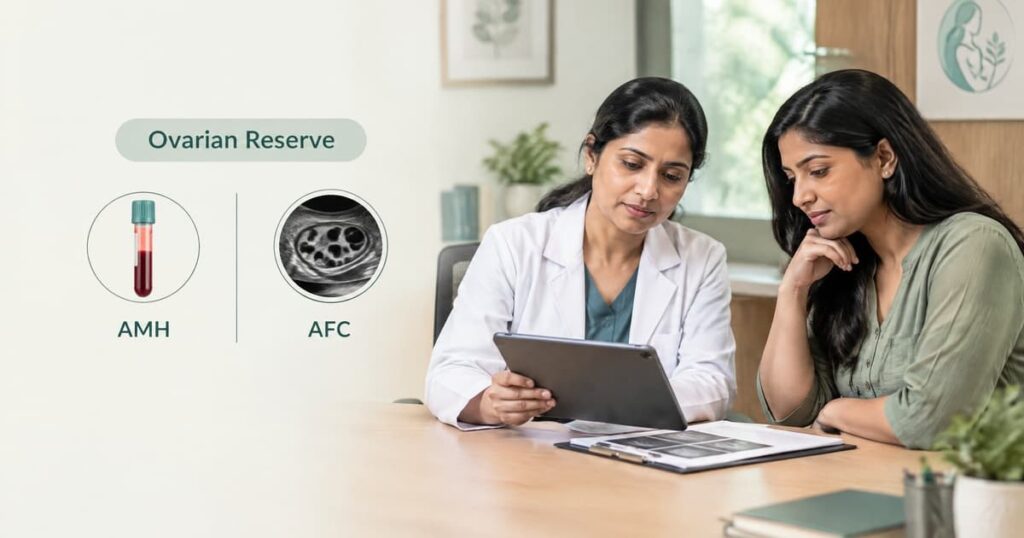
Testing can estimate ovarian reserve (AMH, AFC), confirm whether and when you ovulate, check the fallopian tubes and uterus, and assess a partner’s sperm. What it cannot do is directly measure egg quality or guarantee an outcome. Used well, it clarifies options and timelines rather than delivering a verdict. On timing: it is reasonable to seek evaluation after 12 months of trying if you are under 35, after 6 months if you are 35 or older, and sooner — sometimes straight away — if you are over 40 or have known issues such as PCOS, endometriosis, irregular cycles or recurrent miscarriage. If ovulation itself is the question, Surishi’s what is ovulatory dysfunction is a helpful next read.
What IVF can — and cannot — solve
IVF is often assumed to fix egg quality. It does not. IVF can retrieve more eggs in a cycle, allow embryos to be observed as they develop, and — with genetic testing of embryos — help identify chromosomally normal ones to transfer. But it works with the eggs a woman has; it does not make an older egg younger or correct its chromosomes. This is why success rates with a woman’s own eggs decline with age even with IVF, and why age remains central to any realistic conversation about treatment.
Common egg-quality myths
- “You can reverse egg ageing.” No intervention reverses the chromosomal ageing of eggs. Lifestyle and supplements may support the egg environment; they do not rewrite genetics.
- “A good AMH means good eggs.” AMH reflects quantity, not quality. Quality tracks with age regardless of count.
- “Regular periods mean my eggs are fine.” Regular cycles are reassuring about ovulation, not proof of egg quality or reserve.
- “IVF fixes egg quality.” IVF can select among the eggs you have; it cannot improve an individual egg’s chromosomal status.
- “Egg quality explains every fertility problem.” Tubal, uterine, ovulatory, hormonal and male factors all matter; egg quality is one piece, not the whole.
What women can realistically control — key takeaways
You cannot change your age or reverse the chromosomal ageing of your eggs. You can, however, do several things that genuinely matter: not smoking, moderating alcohol, supporting metabolic health, sleeping well and staying active; taking folic acid and correcting confirmed nutritional deficiencies; understanding your cycle; and — importantly — not delaying evaluation when the timelines above suggest it. Supplements may play a supporting role, best discussed with a clinician and understood for what the evidence does and does not show. The most powerful lever most women have is not a product but time and information: understanding how age affects the odds, and acting on that knowledge early rather than late.
FAQs :
Q1. What is egg quality, in simple terms?
It mainly means whether an egg is chromosomally normal and has the cellular energy to be fertilised and develop into a healthy embryo. It is not something a routine scan or single hormone test can measure directly — it is inferred, largely from age and from how embryos develop.
Q2. Is egg quality the same as ovarian reserve or AMH?
No. Ovarian reserve and AMH estimate quantity — how many eggs remain. Egg quality is a separate axis: how genetically normal those eggs are. A good AMH does not confirm good egg quality, and a low AMH does not mean poor quality; quality tracks mainly with age.
Q3. At what age does egg quality decline?
It declines gradually through the 30s and more noticeably after the mid-30s and into the 40s, mainly because the proportion of chromosomally abnormal eggs rises with age. This describes averages across many women, not any single person’s eggs.
Q4. Can I improve or reverse my egg quality?
You cannot reverse the chromosomal ageing of eggs — no diet, supplement or treatment does that. You can support the environment in which eggs mature through a healthy lifestyle, not smoking, correcting deficiencies and managing metabolic health, which is worthwhile for its own reasons.
Q5. Does CoQ10 improve egg quality?
CoQ10 has a plausible mechanism and has been investigated, with some studies suggesting it may improve certain intermediate markers in women with low reserve or poor IVF response. But evidence that it increases pregnancy or live-birth rates is limited and research is ongoing. It is best seen as under investigation and discussed with a doctor — not a proven treatment.
Q6. Can IVF fix poor egg quality?
No. IVF can retrieve more eggs, observe embryo development, and — with genetic testing — help select chromosomally normal embryos, but it works with the eggs you have and cannot make an older egg younger or correct its chromosomes.
Q7. When should I see a fertility specialist?
After 12 months of trying if you are under 35, or 6 months if you are 35 or older — sooner if you are over 40 or have PCOS, endometriosis, irregular periods or recurrent miscarriage. Testing clarifies options and timelines; it does not deliver a verdict on fertility.
Medical Disclaimer
This article is for educational purposes only and does not diagnose infertility or provide individualized treatment advice. It is not a substitute for consultation with a qualified gynaecologist or reproductive medicine specialist. Egg quality, ovarian reserve and fertility are individual and cannot be assessed from an article; decisions about testing, supplements or treatment should be made with a licensed healthcare professional, ideally guided by appropriate evaluation. No supplement or lifestyle change is claimed to improve egg quality, raise AMH, increase ovarian reserve, or increase pregnancy or live-birth rates, and nothing here should be taken to suggest that age-related chromosomal change can be reversed. If you are planning pregnancy or have concerns about fertility, please seek personalised medical guidance. Surishi Pharmaceuticals’ products referenced here are described for educational context only and should be used only as directed by a healthcare professional.